







Key takeaways
- Credit markets became increasingly bifurcated in Q2 2026, with capital flowing to higher-quality borrowers while sponsor-backed, software, and lower-rated credits faced greater pricing pressure and tighter financing conditions.
- Corporate borrowers sustained leveraged loan issuance as private equity activity slowed, offsetting weaker sponsor demand and demonstrating the resilience of the broadly syndicated loan market.
- Private credit entered a more disciplined phase, with slower deal activity, wider spreads, and growing emphasis on underwriting quality as the market recalibrated.
- The PE exit backlog has become a structural credit issue, constraining capital recycling, influencing lender behavior, and reinforcing the market’s growing divide.
- Looking ahead, refinancing risk, sector selection, and borrower quality, not expectations of lower rates or a rebound in M&A, are likely to define credit markets in the second half of 2026.
Q2 underscored a fundamental shift in the credit markets: capital became more selective, sector dynamics evolved, and financing conditions increasingly depended on borrower quality rather than broad market momentum. Three forces shaped the quarter: a Federal Reserve that has moved to the sidelines, an energy-driven inflation shock tied to the US–Iran conflict, and AI’s disruption of software-sector credits, driving many of the trends explored below.
Leveraged loans: corporates stepped up to fill the PE void
Despite a challenging backdrop, the leveraged loan market proved more resilient than the macro environment suggested. Total activity reached $224 billion in Q2, down just 7% quarter-over-quarter but nearly double Q2 2025 levels, as corporate borrowers stepped in to fill the void left by an increasingly absent PE segment.
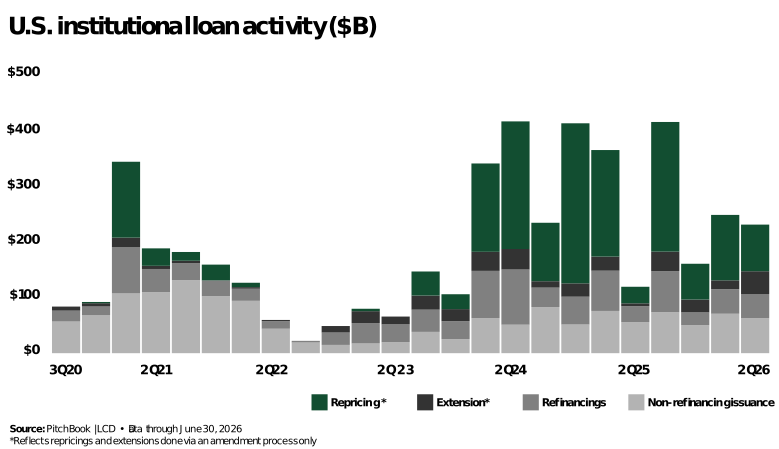
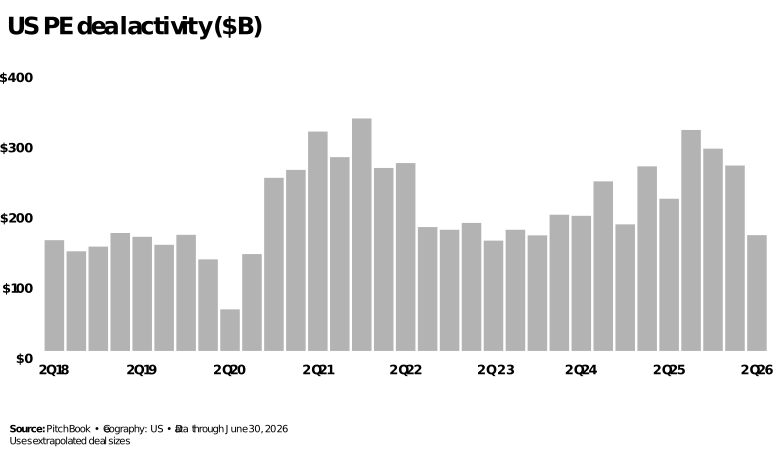
PE activity significantly declined. U.S. PE deal volume fell 38% to $177 billion, its lowest reading in two and a half years, while sponsored loan issuance declined 33% in tandem. In contrast, corporate borrowers raised a five-year high of $53.6 billion.
PE accounted for 74% of all maturity extension amendments during the quarter. Amend-to-extend volume hit a post-Global Financial Crises record of $29.5 billion as PE sponsors raced to address the looming 2028 maturity wall.
At the same time, lenders became increasingly selective. B-minus spreads widened 55 basis points to S+409, while spreads for higher-rated borrowers remained largely unchanged, underscoring a growing divergence at the low end of the credit spectrum.
Sector rotation: software under pressure
Software’s share of broadly syndicated loan issuance fell to just 8.8% year to date, down from 17.6% in 2025 and its lowest level since 2013. In its place, healthcare became the largest sector for institutional loan issuance for the first time since 2015, capturing a record 12.4% of volume.
Private credit: recalibrating
Direct lending activity declined sharply alongside the broader private equity slowdown. No direct-lender LBO over $2 billion has closed since early March, while spreads on “down-the-fairway” deals have widened 25 to 50 basis points as lenders reset terms in a more cautious environment.
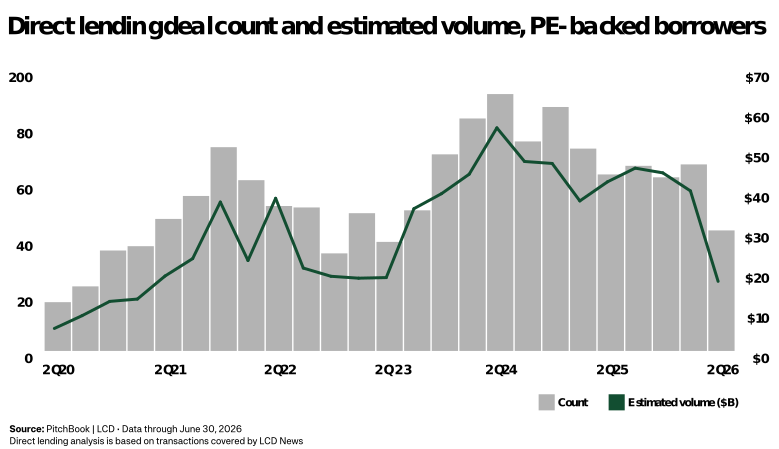
BDC redemption pressure also intensified in Q2. While redemption caps are functioning as intended and liquidity reserves remain healthy, the increase in redemption requests underscores that the private credit market that is normalizing after several years of rapid growth.
The PE exit bottleneck
A decade-long backlog of unsold PE portfolio companies is compounding the market’s bifurcation. What began as a temporary slowdown in exits has become a structural feature of the PE landscape, leaving sponsors with aging portfolios that can’t easily be monetized at acceptable valuations.
The result is a growing mismatch between capital deployed and capital returned, reshaping how limited partners allocate capital, how general partners raise new funds, and how lenders evaluate risk. This overhang is no longer solely a PE problem. It’s a credit market problem.
- ~29,000 unsold companies in global PE portfolios (Source: Bain 2026 Global PE Report)
- ~$3.6 trillion in unrealized value, only modestly reduced by the 2024–2025 recovery in exits
- Holding periods exceeding 6.5 years, versus a historical average of roughly four years
- Investment-to-exit ratio near 2:1, with sponsors continuing to acquire roughly twice as many companies as they exit
Looking ahead: what the rest of 2026 may hold
If H1 2026 demonstrated anything, it’s that the old playbook – waiting for the Fed to cut rates, waiting for M&A activity to rebound, or waiting for the exit window to reopen – is no longer sufficient. H2 is likely to be defined less by a single catalyst than by how borrowers, sponsors, and lenders navigate a market that has quietly rewritten its own rules.
Several themes are worth watching:
- The 2028 maturity wall moves from horizon to the forefront: With amend-to-extend activity already at post-Global Financial Crisis records, expect a growing share of H2 activity to be defensive rather than offensive. Refinancings, liability management exercises, and creative capital solutions are likely to take precedence over new-money financings for borrowers that can’t simply grow through the challenge.
- Market bifurcation deepens before it narrows: High-quality borrowers should continue to attract aggressive lender bids, tight spreads, and covenant-lite terms. Marginal credits will face wider spreads, tighter structures, and a much smaller pool of willing capital providers. The middle of the market continues to erode.
- Private credit’s next phase is about discipline rather than growth: After years of rapid AUM expansion, portfolio management, workout capability, and underwriting discipline are becoming increasingly important competitive differentiators. Recent BDC redemption pressure appears to be the beginning of this transition and not its conclusion.
- Sector leadership remains fluid: Healthcare’s rise and software’s retreat may prove to be more than a temporary rotation. AI-driven disruption of legacy software business models increasingly looks like a structural credit story rather than a cyclical one, requiring lenders to underwrite technology risk with sharper scrutiny.
H2 will likely reward preparation over prediction. Sponsors that have used the slower deal environment to strengthen financial reporting, improve operating performance, and present a credible long-term growth strategy continue to find capital available. Those still waiting for markets to return to prior conditions may discover that the next phase of the cycle unfolds unevenly.
Ultimately, the defining question for the balance of 2026 is not whether the cycle turns, but which side of the market’s growing bifurcation each borrower, sponsor, and lender occupies when it does.
Partner with Sikich Investment Banking’s Capital Advisory team to navigate the credit markets, access capital, and structure customized debt and equity solutions for growth, acquisitions, recapitalizations, and liquidity events.
Our Q1 2026 credit market update can be found here.
About our authors
Mike Rudolph is a Managing Director at Sikich Corporate Finance. He has nearly 25 years of experience orchestrating senior debt (cash flow and asset-based), junior capital, and equity financings for leveraged buyouts, recapitalizations, private placements, and balance sheet restructurings. Mike.rudolph@sikich.com
Doug Christensen is a Director at Sikich Corporate Finance. He provides capital structure advisory and capital raising support for private clients, with expertise across senior debt, junior capital and equity financing. Doug.christensen@sikich.com
Securities offered through Sikich Corporate Finance LLC, member FINRA/SIPC
This publication contains general information only and Sikich is not, by means of this publication, rendering accounting, business, financial, investment, legal, tax, or any other professional advice or services. This publication is not a substitute for such professional advice or services, nor should you use it as a basis for any decision, action or omission that may affect you or your business. Before making any decision, taking any action or omitting an action that may affect you or your business, you should consult a qualified professional advisor. In addition, this publication may contain certain content generated by an artificial intelligence (AI) language model. You acknowledge that Sikich shall not be responsible for any loss sustained by you or any person who relies on this publication.