







Key takeaways
- Credit markets remained resilient in Q3 despite geopolitical tensions, persistent inflation, and renewed interest rate volatility. Strong investor demand continued to support leveraged loans and private credit.
- M&A financing accelerated late in the quarter, with September delivering the strongest month for M&A-related loan issuance since January 2022.
- Credit markets continue to bifurcate, with capital concentrated in larger, higher-quality credits while B-minus borrowers face wider spreads and more selective lenders.
- Refinancing activity increased as issuers addressed the approaching 2028 maturity wall, though costs rose materially for lower-rated borrowers.
- Private credit remains flush with capital, but large-cap buyout volumes are subdued. Performance concerns are increasingly concentrated in lower-middle-market and software-related portfolios.
- Default expectations are rising, though stress remains concentrated in select sectors and lower-quality credits.
U.S. institutional loan market activity
Activity in the broadly syndicated loan market moderated during Q3, with approximately $195 billion of institutional issuance, the lowest quarterly level of 2026. However, this decline largely reflects slower amendment and repricing activity, while new-money issuance remained healthy.
Year-to-date institutional loan activity totaled approximately $659 billion through September 30, down 24% from the same period in 2025. Most of the decline resulted from fewer opportunistic refinancing and repricing transactions, not acquisition- or growth-related financings.
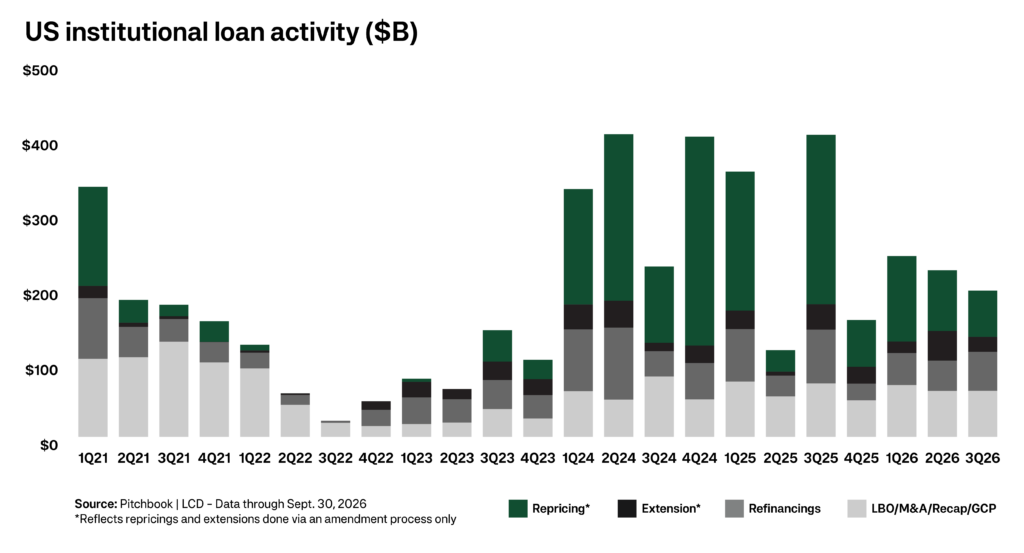
One encouraging development is the improving composition of issuance. Loans supporting buyouts, acquisitions, recapitalizations, and general corporate purposes totaled approximately $192 billion through the first nine months of the year, essentially matching 2025 levels. This suggests the market is increasingly supporting M&A and other economic activity rather than just refinancing transactions.
Strong CLO issuance and improving fund inflows supported loan prices during the quarter, contributing to the asset class’s strongest quarterly return since Q2 2025. Investor demand exceeded net loan supply for much of the quarter, supporting secondary market pricing and reinforcing favorable technical conditions.
M&A financing activity rebounds
After a sluggish start to the quarter, M&A financing activity accelerated sharply during September. M&A-related institutional loan issuance reached $39.9 billion during Q3, with September alone contributing $30.6 billion, the highest monthly total since January 2022.
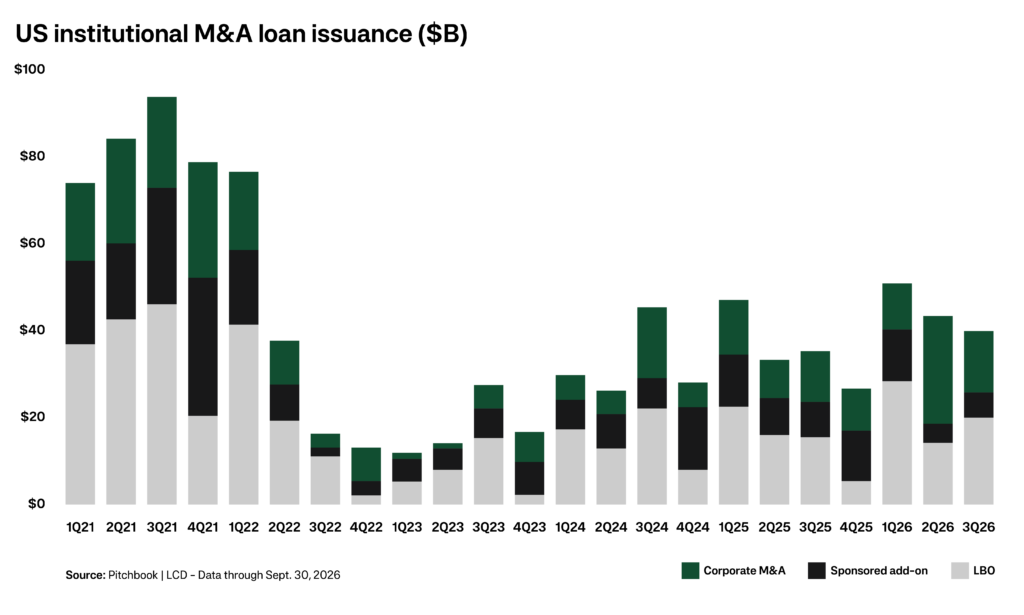
The rebound was driven by a resurgence in large transactions. September featured 12 acquisition-related term loans exceeding $1 billion, the highest monthly count in five years. Eight of those transactions supported leveraged buyouts, reflecting improving sponsor confidence and greater lender willingness to support select acquisition opportunities.
Investors remained highly selective despite the transaction activity improvement. Nearly half of all M&A loan volume went to borrowers rated BB- or higher, the largest share since the Global Financial Crisis. In contrast, only 14% of M&A issuance went to B-minus rated borrowers, well below historical averages.

Software’s dominance continued to fade. It accounted for only 10% of new leveraged loan issuance, while healthcare and media led new financings. Investors continue to favor businesses with stable cash flows, defensive characteristics, and lower exposure to potential AI-driven disruption.
M&A: broadly syndicated loans vs. private credit
The broadly syndicated loan market’s momentum contrasts with conditions in private credit.
Direct lending volume supporting LBOs totaled approximately $10.7 billion in Q3, down from Q2 2026 and Q3 2025 levels. Large sponsor transactions remain limited despite abundant private credit capital.
Competition for attractive deals remains intense, particularly for non-software businesses and lower-middle-market borrowers. As a result, private credit spreads have tightened despite subdued overall deal activity. Meanwhile, the syndicated market has recaptured several larger financings that may have migrated to private credit in recent years.
Private credit lenders remain well positioned with significant dry powder but are increasingly focused on portfolio diversification, lower-middle-market opportunities, and sectors less exposed to technology disruption. The result is a market with abundant capital, disciplined underwriting, and fierce competition for high-quality borrowers.
Chipping away at the 2028 maturity wall
Addressing the approaching 2028 maturity wall was a defining industry theme of Q3.
Refinancing activity increased as issuers worked to extend upcoming maturities. Borrowers rated B-minus or below represent the largest share of 2028 maturities, making them the primary focus of refinancing activity.
Progress has been uneven. Higher-quality borrowers rated B and B+ have reduced much of their 2028 maturities, while lower-rated issuers have made less progress and face greater refinancing pressure.
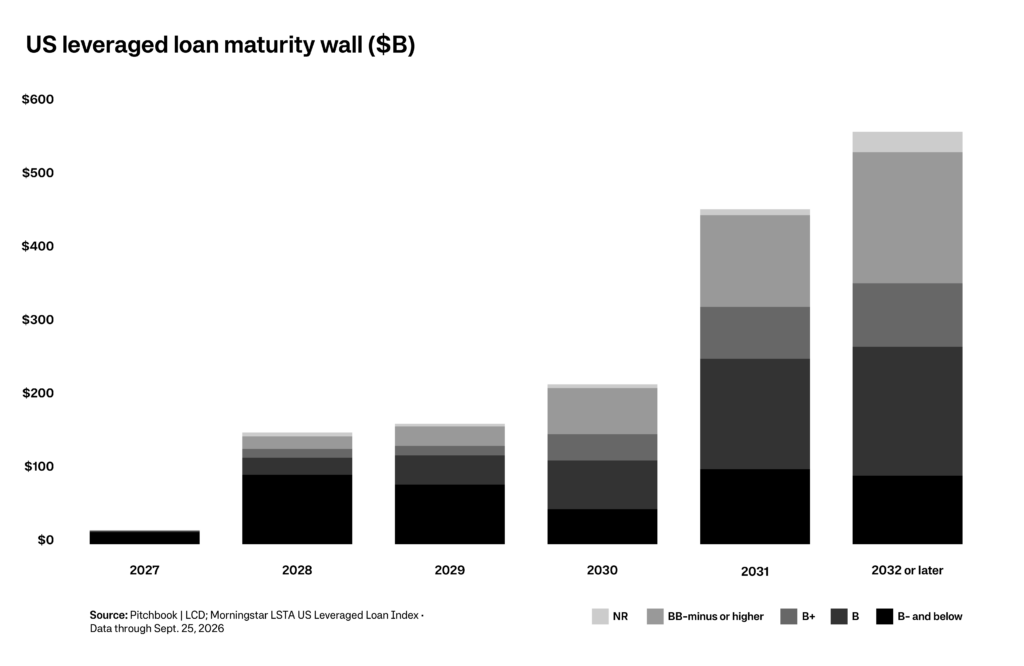
The market remains open for refinancing transactions, but lenders have become increasingly selective. Lower-rated borrowers generally pay higher spreads to extend maturities due to their higher perceived risk.
With substantial maturities still scheduled for 2028 and 2029, refinancing activity should remain a key driver of loan issuance through Q4 and into 2027.
Default update
Default activity remains manageable, but credit pressure continue to build. Market participants increasingly expect defaults and restructurings to rise modestly over the next six months as higher rates, refinancing needs, and tighter credit conditions pressure weaker borrowers.
Stress remains concentrated rather than systemic, particularly among smaller borrowers, select healthcare credits, and lower-rated issuers facing upcoming maturities. Higher-quality companies continue to perform well and maintain access to capital.
Looking ahead: Q4 2026
Key themes are likely to shape credit markets through year-end:
- Continued M&A recovery: September’s surge in acquisition financing suggests improving sponsor confidence and a stronger Q4 pipeline.
- Increased refinancing activity: Borrowers, particularly lower-rated issuers, are expected to continue addressing 2028 maturities.
- Further market bifurcation: Higher-quality borrowers should continue to command attractive pricing, while weaker credits face wider spreads and stricter underwriting.
- Persistent scrutiny of software credits: While software performance improved during Q3, lenders remain cautious about AI-related disruption and long-term business-model risk.
- Intense private credit competition: Significant dry powder and limited deal flow should continue supporting aggressive pricing for attractive middle-market opportunities.
- Modestly higher default activity: Elevated rates, inflation, and approaching maturities are expected to drive increased restructurings and liability-management activity.
- Continued CLO support: Strong investor demand and favorable technicals should continue supporting liquidity for the leveraged loan market.
Closing perspective
Q3 marked a meaningful improvement in new-money financing activity while reinforcing a defining theme of 2026: borrower quality matters. Capital remains available, M&A activity is improving, and investor demand is healthy. As the 2028 maturity wall approaches, stronger credits continue to benefit from abundant liquidity, while lower-rated borrowers face rising refinancing costs and heightened lender scrutiny.
Our Q2 2026 credit market update can be found here.
About our authors
Mike Rudolph is a Managing Director at Sikich Corporate Finance. He has nearly 25 years of experience orchestrating senior debt (cash flow and asset-based), junior capital, and equity financings for leveraged buyouts, recapitalizations, private placements, and balance sheet restructurings. Mike.Rudolph@sikich.com
Doug Christensen is a Director at Sikich Corporate Finance. He provides capital structure advisory and capital raising support for private clients, with expertise across senior debt, junior capital and equity financing. Doug.Christensen@sikich.com
This publication contains general information only and Sikich is not, by means of this publication, rendering accounting, business, financial, investment, legal, tax, or any other professional advice or services. This publication is not a substitute for such professional advice or services, nor should you use it as a basis for any decision, action or omission that may affect you or your business. Before making any decision, taking any action or omitting an action that may affect you or your business, you should consult a qualified professional advisor. In addition, this publication may contain certain content generated by an artificial intelligence (AI) language model. You acknowledge that Sikich shall not be responsible for any loss sustained by you or any person who relies on this publication.