







Following the Supreme Court’s ruling that the International Emergency Economic Powers Act did not authorize certain tariffs, companies have understandably focused on one immediate question: How do we record the expected refund?
For some businesses, that question is no longer hypothetical. Refund claims are being processed and, after receiving a refund, companies are reaching out to ask what to do and specifically whether the amount could be recorded back to 2025.
It’s an understandable question. Potential recoveries can be significant, and finance teams want to understand where and when those amounts should be reflected in the financial statements. The increase in costs reflected in 2025 may now be offset with a corresponding decrease in 2026, creating potentially significant period-to-period comparability and covenant effects. However, much of the discussion so far across the accounting profession has focused on recognition models, gain contingencies, loss recoveries, and subsequent event considerations.
Yet in many cases, companies may be starting their analysis at the end.
A tariff refund is not a standalone check from the government. It is the latest development in a chain of transactions. Accounting for the refund without tracing that chain can produce an incomplete answer. Before management determines when and where to record a recovery, it should work through three questions: Does the company have a supportable claim? Who will retain the economic benefit? What does the refund represent for accounting purposes?
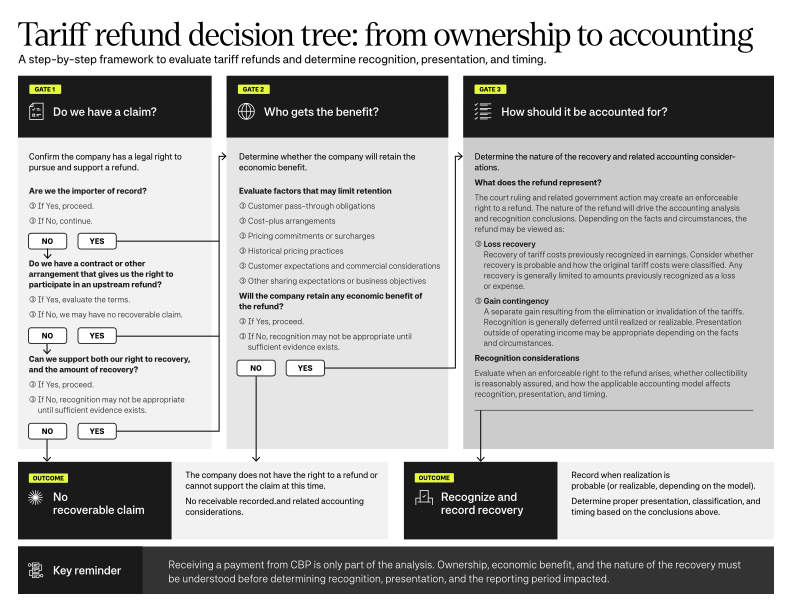
So, what now?
Determine who owns the claim
Many companies incurred the economic cost of tariffs, but not every company necessarily has a direct claim against U.S. Customs and Border Protection (CBP).
One of the first facts management should establish is whether the company is the importer of record. A business that purchased imported products through a distributor, logistics provider, customs broker, or other intermediary may have absorbed tariff-related costs without possessing the direct right to recover those amounts from the government. In that case, any recovery may depend on a separate contractual arrangement with the party that holds the refund right. The belief that the company paid higher costs as a result of increased tariffs is not enough.
Appropriate documentation is central to both the refund request and the related accounting. CBP may review a claim to determine whether the importer was entitled to the refund, making the process fundamentally documentation based. That same support will also be important if the company records a receivable, since its financial statement auditor will need evidence supporting the company’s right to recovery and the amount recognized.
CBP has established its Consolidated Administration and Processing of Entries, or CAPE, functionality within the Automated Commercial Environment, or ACE, to process eligible refund requests. CBP’s implementation is phased, and available procedures vary depending on the status and characteristics of the affected entries. Companies should use the CBP IEEPA Duty Refunds resource for current filing information and coordinate with their customs brokers or trade advisors regarding their specific entry populations.
This leads to a practical test: if management were asked to support the expected refund tomorrow, could the company establish both its right to the recovery and the amount?
The question few companies are asking
Most discussions focus on whether the company will receive a refund. A more important question may be whether the company ultimately retains the economic benefit.
Receiving a payment from CBP answers only part of the ownership question.
- Many organizations responded to tariffs by increasing prices, implementing tariff surcharges, renegotiating contracts, operating under cost-plus arrangements, or otherwise incorporating higher import costs into their commercial decisions. As a result, the party receiving the refund may not be the only party with an economic interest in it.
- Consider a manufacturer that imposed a tariff surcharge when import costs increased. As a legal matter, the company may be entitled to a refund from CBP. However, management should also consider whether contractual arrangements, historical pricing practices, customer expectations, or broader commercial objectives influence how much of that benefit the company ultimately expects to retain.
- Similarly, companies operating under cost-plus arrangements may conclude that customers effectively reimbursed some or all the tariff costs as they were incurred. In those circumstances, management may need to consider whether receiving a refund changes its economic position at all.
The point is not that companies must share tariff refunds with customers. In many situations, they may have no contractual obligation to do so. Rather, the right to receive a refund does not necessarily determine who ultimately benefits from it. Management may still need to consider customer relationships, prior pricing decisions, competitive pressures, and other commercial factors when evaluating the economic impact of the recovery.
For some organizations, understanding who ultimately receives the benefit of the recovery may be more important than determining where the resulting journal entry belongs.
From economics to accounting
Eventually, most controllers arrive at the practical question: If we receive a refund, where does it go?
The answer depends on the conclusions reached in the earlier stages of the analysis. Before determining whether a receivable should be recognized, where a recovery belongs in the income statement, or whether a portion of the refund affects assets still carried on the balance sheet, management first needs to understand what the refund represents economically.
U.S. GAAP does not contain a model written specifically for refunds arising from invalidated tariffs. As a result, companies may characterize the recovery in different ways. Those conclusions can influence recognition and presentation, but they do not eliminate the separate question of which reporting period should reflect the recovery.
- Loss recovery: The refund recovers a tariff cost that previously reduced earnings. By analogy to the loss-recovery guidance, a receivable may be recognized when realization is probable, subject to the facts and remaining uncertainties. The recognized recovery generally would not exceed the loss previously recognized. To the extent there is a direct link to the prior cost, management should evaluate whether the recovery belongs in the same income statement classification, such as a reduction of cost of sales or the related operating expense.
- Gain contingency: The refund is a separate gain resulting from the invalidation of the tariffs rather than a recovery of a recognized loss. Recognition generally would be deferred until the gain is realized or realizable. Presentation in other income may be appropriate if the amount is not treated as a reversal of the original cost.
- Change in legal status: The court ruling changed the enforceability and legal status of the affected tariffs. The accounting consequences are therefore evaluated based on the rights and conditions arising from the ruling rather than solely by reference to the period in which the tariffs were originally paid.
Which reporting period should reflect the recovery?
Regardless of how the recovery is characterized, management must determine the appropriate reporting period.
Some companies may conclude that the effects of the recovery should be reflected in a reporting period that ended before the February 2026 ruling, particularly if the ruling provides additional evidence about conditions that existed at the balance sheet date and the financial statements had not yet been issued or made available for issuance. Others may conclude that the ruling created or materially changed the enforceable refund right, supporting recognition only in a later period.
The conclusion will depend on the conditions that existed at the reporting date, the status of the claim, the information available before the financial statements were issued, and the recognition requirements of the accounting model applied. The later invalidation of the tariffs, by itself, does not establish that previously issued financial statements were incorrect.
The company’s conclusion should follow the substance of the recovery, not the desired recognition date or income statement location.
The original cost may still be on the balance sheet
The presentation analysis is comparatively straightforward when the tariff cost was recognized in a prior period’s income statement. In that case, management may conclude that the recovery should be recorded in the same income statement classification as the original cost, even though the cost and recovery appear in different reporting periods.
The analysis is more complicated when some or all of the tariff remains capitalized. Tariffs associated with unsold inventory may still be included in inventory, while tariffs on goods already sold may have flowed through cost of sales. Management may need to trace the refund to those populations rather than record the entire amount as current-period income.
A similar issue arises when tariffs were capitalized as part of property, plant, and equipment. To the extent the related asset remains on the balance sheet, management may need to consider whether the recovery should be reflected through the asset’s carrying amount, with corresponding effects on future depreciation, rather than automatically treating the refund as current-period income.
The practical point is that the refund should not automatically be credited entirely to current-period expenses or other income when the original tariff cost has not entirely reached the income statement.
The decision about sharing the recovery should not wait
The accounting analysis does not end once management concludes that a refund is expected.
Many organizations are still evaluating what they will do if a refund is received. Some may determine that contractual arrangements require a portion of the recovery to be shared with customers or passed through the supply chain. Others may conclude that customer relationships, pricing strategies, competitive pressures, or broader commercial considerations make sharing some portion of the benefit the more appropriate business decision.
Whatever conclusion management reaches, timing matters.
The original tariffs may have affected one reporting period, the refund may affect a second, and subsequent customer credits, pricing concessions, or vendor settlements may affect a third. Waiting to address the commercial consequences of the refund can therefore create another period of tariff-related volatility.
Companies that expect to share some portion of the recovery should evaluate those effects as part of the same analysis rather than automatically treating them as unrelated future events. That does not mean a liability should be recognized before the applicable recognition criteria are met. It does mean management should distinguish between contractual obligations, other present obligations supported by the facts, and voluntary commercial actions it is considering.
Conversely, a company that was not the importer of record but believes it absorbed tariff costs charged by a distributor, supplier, or other intermediary should determine whether its agreements or the parties’ course of dealing provide a right to receive any portion of an upstream refund.
In both cases, the objective is the same: The accounting should reflect the expected economic outcome, not merely which party receives the refund first.
Bringing the analysis together
Receiving the check is the easiest part. The harder work is determining who owns the claim, what cost is being recovered, and whether the company expects to retain the full economic benefit of the recovery.
Only after those questions are answered can management determine the appropriate accounting treatment, including when the recovery should be recognized, where it should be presented, and whether a portion affects assets or obligations that remain on the balance sheet.
Companies that perform that analysis before booking the refund will be in a much better position to support their conclusions, explain the accounting, and avoid creating multiple periods of tariff-related volatility.
Tariff refund claims often involve accounting, tax, customs, contractual, and commercial considerations that extend well beyond the initial journal entry. Companies facing significant refunds should consider involving their accounting, tax, legal, and trade advisors early in the process to evaluate both the financial reporting implications and the broader economic consequences of the recovery.
As tariff refund programs mature and refund claims move from possibility to probability, companies should reassess the timing and measurement of any related accounting impacts. The accounting questions often become more challenging after a refund opportunity is identified, particularly when recovery amounts remain subject to review, litigation, administrative processing, or other uncertainties.
Sikich professionals can assist you in assessing refund eligibility, evaluating accounting conclusions, and navigating the related financial reporting considerations.
This publication contains general information only and Sikich is not, by means of this publication, rendering accounting, business, financial, investment, legal, tax, or any other professional advice or services. This publication is not a substitute for such professional advice or services, nor should you use it as a basis for any decision, action or omission that may affect you or your business. Before making any decision, taking any action or omitting an action that may affect you or your business, you should consult a qualified professional advisor. In addition, this publication may contain certain content generated by an artificial intelligence (AI) language model. You acknowledge that Sikich shall not be responsible for any loss sustained by you or any person who relies on this publication.