







Building wealth is only part of your story. Deciding how this wealth reflects your family’s values and the legacy you hope to leave is equally important. For many high-net-worth families, charitable giving is one of the most effective ways to put these values into action across generations. Beyond supporting meaningful causes, philanthropy encourages stewardship, creates shared experiences, and demonstrates that wealth can be used to improve the lives of others.
A flexible vehicle for charitable planning
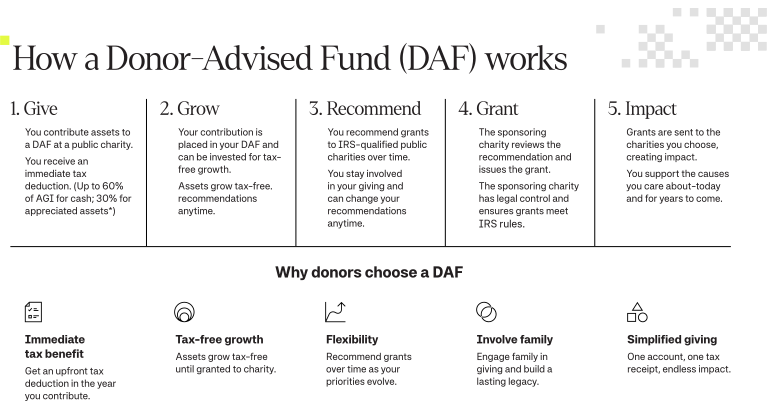
The donor-advised fund (DAF) is one of the most flexible charitable planning vehicles available. A donor contributes assets to the fund, receives an immediate income tax deduction (subject to applicable limitations), and then recommends grants to IRS-qualified public charities over time. Contributed assets can be invested and grow tax-free until grants are distributed, letting donors separate the timing of their tax deduction from their charitable decisions.
This flexibility can be especially valuable during years of unusually high income. Contributions made after the sale of a business, the exercise of stock options, a substantial bonus, or significant capital gains may reduce current taxable income while giving the donor time to decide which organizations should ultimately benefit. Many taxpayers also use a DAF to “bunch” several years of charitable contributions into one tax year to maximize itemized deductions.
DAFs can also improve the tax efficiency of charitable giving. Contributing long-term appreciated securities generally allows donors to avoid capital gains tax while getting a charitable deduction based on fair market value (subject to applicable tax rules). Many sponsoring organizations also accept closely held business interests and other complex assets, preserving more of the contribution for charitable purposes rather than taxes.
Consider a business owner preparing to sell a closely held company. Contributing a portion of the ownership interest before the sale may generate an immediate charitable deduction, reduce capital gains exposure, and establish a charitable account that can support important causes for decades. For many entrepreneurs, integrating charitable planning before a liquidity event can transform a tax obligation into an opportunity to build a lasting philanthropic legacy.
In summary, a DAF may be worth considering if you are:
- Selling a business
- Exercising stock options
- Holding highly appreciated assets
- Experiencing an unusually high-income year
- Realizing significant capital gains
- Receiving a substantial bonus
- Developing a multi-generational charitable giving strategy
Building a legacy, not just a deduction
For many successful families, the greatest value of a DAF extends beyond the tax deduction. It’s the structured way to make charitable giving an enduring family tradition.
Many families involve children and grandchildren in researching charities, recommending grants, and reviewing the impact of prior giving. Others develop a philanthropic mission statement or rotate leadership responsibilities. These activities foster stewardship and reinforce shared values.
A DAF also offers many of the benefits of a private foundation without the administrative complexity, annual tax filings, excise tax considerations, or governance responsibilities. While private foundations remain appropriate in certain situations, a DAF often provides a simpler, more cost-effective alternative.
Successor advisors can continue recommending grants after the original donor’s lifetime. However, DAFs also come with important considerations: contributions are irrevocable, grants generally must go to IRS-qualified public charities, and the sponsoring organization retains legal control of contributed assets. Donors should consult their tax, legal, and financial advisors to ensure a DAF complements their broader financial, tax, and estate planning strategy.
Whether you’re preparing for a liquidity event, donating appreciated assets, or developing a philanthropic legacy, Sikich’s wealth management and tax consulting professionals can help you evaluate whether a DAF is right for you.
About our authors
Larry Johnson, CPA, MST, is a Senior Tax Manager. He advises clients on complex tax matters with expertise in exempt organizations, charitable gift planning, fundraising strategy, and donor relations. His background includes significant work with nonprofit organizations, board development, and philanthropic planning. He serves in leadership roles supporting historical and community organizations, including the Illinois National Guard and Militia Historical Society, reflecting his strong commitment to legacy, service, and mission-driven work. Larry.johnson@sikich.com
Wesley Whamond, CFP, MBA, is a Financial Advisor with over 20 years of experience in the financial services industry. He has a passion for partnering with clients to navigate the financial world. In his role, he takes an encompassing, goals-based approach to tailor solutions to the needs of his clients. He has in-depth expertise in financial planning, investments, financial education and portfolio reviews, servicing clients of all backgrounds. Wesley.whamond@sikich.com
This publication contains general information only and Sikich is not, by means of this publication, rendering accounting, business, financial, investment, legal, tax, or any other professional advice or services. This publication is not a substitute for such professional advice or services, nor should you use it as a basis for any decision, action or omission that may affect you or your business. Before making any decision, taking any action or omitting an action that may affect you or your business, you should consult a qualified professional advisor. In addition, this publication may contain certain content generated by an artificial intelligence (AI) language model. You acknowledge that Sikich shall not be responsible for any loss sustained by you or any person who relies on this publication.