







For many organizations, enterprise resource planning systems (ERP) have been the backbone of business operations for decades. They manage finance, inventory, supply chain, reporting, and core business processes. But the demands placed on ERP have changed. Leaders now need real-time visibility, faster decisions, connected data, and the flexibility to respond quickly to market shifts, customer expectations, and competitive pressure.
That is why ERP modernization is no longer just an IT initiative. It is a business transformation priority. With Microsoft Dynamics 365 ERP solutions and AI agents, organizations can move from rigid legacy systems to intelligent operations that help people work smarter, processes run faster, and leaders act with greater confidence.
Why AI in ERP can’t wait
Legacy ERP systems were built for a different era. They were designed to record transactions, enforce controls, and standardize operations. Those capabilities still matter, but they are no longer enough. Businesses today need systems that can connect information across departments, surface insights in real time, and support decisions before issues become disruptions.
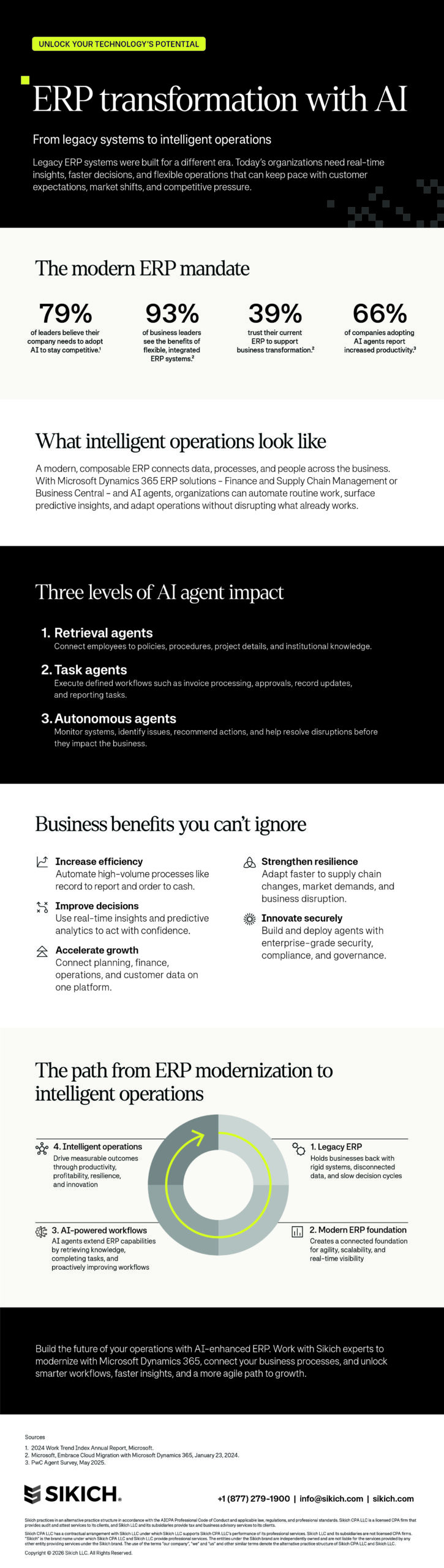
The urgency is clear. Microsoft and LinkedIn’s 2024 Work Trend Index found that 79% of leaders believe their company needs to adopt AI to stay competitive. At the same time, many organizations are still working through how to turn AI experimentation into measurable business impact. ERP is one of the most practical places to begin because it sits at the center of the business and touches the processes that determine productivity, profitability, and customer experience.
The modern ERP mandate
Modern ERP must do more than store data. It needs to create a connected foundation for agility, scalability, and intelligent decision-making. Flexible, integrated ERP platforms help organizations unify finance, operations, supply chain, sales, and customer data so teams can work from the same source of truth.
That connected foundation is especially important as AI becomes embedded into everyday business applications. AI agents can help retrieve institutional knowledge, complete defined tasks, monitor systems, recommend actions, and support more resilient operations. But their value depends on the quality, accessibility, and governance of the data and workflows around them.
What intelligent operations look like
Intelligent operations happen when ERP, data, automation, and AI work together across the business. Instead of relying on manual processes, disconnected spreadsheets, and delayed reporting, teams can use AI-enhanced ERP to automate routine work, identify trends earlier, and respond with greater speed and accuracy.
In Microsoft Dynamics 365 Finance and Supply Chain Management (D365 F&SCM), and Business Central (D365 BC), AI capabilities can support the way finance, operations, supply chain, and business teams work every day. Employees can find information faster, reduce repetitive tasks, improve forecasting, and focus more time on strategic work. Leaders can gain clearer visibility into business performance and make decisions based on timely, connected insights.
Three ways AI agents extend ERP value
AI agents can create value at different levels depending on the workflow, business need, and level of autonomy required. For ERP environments, three types of impact are especially relevant:
- Retrieval agents connect employees to policies, procedures, project details, and institutional knowledge so they can find answers faster and reduce time spent searching across systems.
- Task agents execute defined workflows such as invoice processing, approvals, record updates, and reporting tasks, helping teams reduce manual effort and improve consistency.
- Autonomous agents monitor systems, identify issues, recommend actions, and help resolve disruptions before they impact the business. For example, the Supplier communications agent in D365 F&SCM fields emails, assesses supply disruptions, and updates purchase orders in real-time to keep operations flowing no matter the circumstance.
Together, these capabilities shift ERP from a system of record to a more active system of insight and action. People remain in control, but AI helps remove friction, accelerate work, and surface opportunities that might otherwise be missed.
Business benefits you can’t ignore
AI-enhanced ERP can help organizations improve performance across the business. The most meaningful benefits often come from combining process modernization, connected data, and practical AI use cases that align with business goals.
- Increase efficiency: Automate high-volume processes like record to report, order to cash, invoice processing, and routine approvals.
- Improve decisions: Use real-time insights and predictive analytics to act with confidence.
- Accelerate growth: Connect planning, finance, operations, and customer data on one platform.
- Strengthen resilience: Adapt faster to supply chain changes, market demands, and business disruption.
- Innovate securely: Build and deploy agents with enterprise-grade security, compliance, and governance.
These outcomes are already taking shape in the market. PwC’s 2025 AI Agent Survey found that 79% of companies are adopting AI agents, and two-thirds of those adopters report measurable productivity gains. The next step is moving beyond isolated productivity improvements and using AI to rethink how work gets done across connected business processes.
The path from ERP modernization to intelligent operations
ERP transformation does not have to happen all at once. The most effective approach is often a phased journey that aligns technology modernization with business priorities, process improvement, and change readiness.
- Move beyond legacy limitations. Identify where rigid systems, disconnected data, manual work, and slow reporting are holding the business back.
- Create a modern ERP foundation. Connect core processes and data in a flexible platform that supports agility, scalability, and real-time visibility.
- Introduce AI-powered workflows. Apply AI agents to practical use cases where automation, insight, and workflow support can deliver measurable value.
- Scale toward intelligent operations. Expand AI-enabled capabilities across functions to improve productivity, profitability, resilience, and innovation.
This progression helps organizations modernize with purpose. Instead of adding AI to outdated processes, businesses can build the right ERP foundation first, then extend it with AI capabilities that support real operational change.
Build the future of your operations with AI-enhanced ERP
AI is changing what organizations should expect from ERP. The opportunity is not just to automate tasks, but to create smarter workflows, faster insights, and more adaptive operations. With the right strategy, modern ERP can become the foundation for business transformation and long-term growth. Connect with Sikich experts to modernize with Microsoft Dynamics 365, link your business processes, and unlock a more agile path to intelligent operations.
This publication contains general information only and Sikich is not, by means of this publication, rendering accounting, business, financial, investment, legal, tax, or any other professional advice or services. This publication is not a substitute for such professional advice or services, nor should you use it as a basis for any decision, action or omission that may affect you or your business. Before making any decision, taking any action or omitting an action that may affect you or your business, you should consult a qualified professional advisor. In addition, this publication may contain certain content generated by an artificial intelligence (AI) language model. You acknowledge that Sikich shall not be responsible for any loss sustained by you or any person who relies on this publication.