







Most investors focus heavily on asset allocation — how much to invest in stocks, bonds, and cash. But a quieter, often overlooked lever can meaningfully improve after-tax returns: asset placement, sometimes referred to as “tax alpha.”
Simply put, asset placement is about putting the right investments in the right accounts based on how they are taxed. When done thoughtfully, it can increase long-term wealth without increasing investment risk.
What is “tax alpha”?
“Tax alpha” refers to the additional wealth an investor can create by reducing taxes – not by taking on more investment risk or generating higher pre-tax returns.
Even if two investors hold identical portfolios, the one who manages tax exposure more effectively can end up significantly ahead over time.
The basics of asset placement
Asset placement starts with understanding two things: how different investments are taxed and how different account types treat taxes.
Investment types are taxed differently:
- Interest income (bonds, CDs, money markets): Taxed at ordinary income rates (often the highest rates)
- Qualified dividends and long-term capital gains (stocks, ETFs): Taxed at preferential lower rates
Account types have different tax treatments:
- Tax-deferred accounts (IRAs, 401(k)s): Taxes are postponed until withdrawal.
- Tax-exempt accounts (Roth IRA): There is no taxation.
- Taxable brokerage accounts: Taxes are due annually on dividends, interest, and realized gains.
The principle of asset placement is simple: place tax-inefficient assets in tax-advantaged accounts, and tax-efficient assets in taxable accounts.
A simple example
Consider two types of investments:
- Bonds (tax-inefficient): Generate interest taxed at ordinary income rates
- Stocks (more tax-efficient): Generate qualified dividends and long-term capital gains
A tax-efficient placement strategy would look like:
| Account type | Ideal assets |
| IRA / 401(k) | Bonds, REITs, high-income funds |
| Taxable brokerage | Stocks, index funds, ETFs, municipal bonds |
| Roth IRA | Potential high-growth investment mix |
By placing bonds in an IRA, you defer or avoid annual taxation on interest income. Meanwhile, holding stocks in a taxable account allows you to benefit from lower capital gains rates and tax deferral on unrealized gains.
Why this matters: the compounding effect
Taxes act as a drag on compounding. Every dollar paid in taxes today is a dollar that cannot grow in the future. By minimizing annual tax friction:
- More capital stays invested
- Compounding accelerates
- After-tax returns improve over time
Even a seemingly modest tax savings of 0.25%–0.75% annually can lead to meaningful differences over decades, especially for high-income investors. The graph below illustrates the advantage of a portfolio utilizing tax alpha, resulting in higher after-tax annual earnings of .5%.
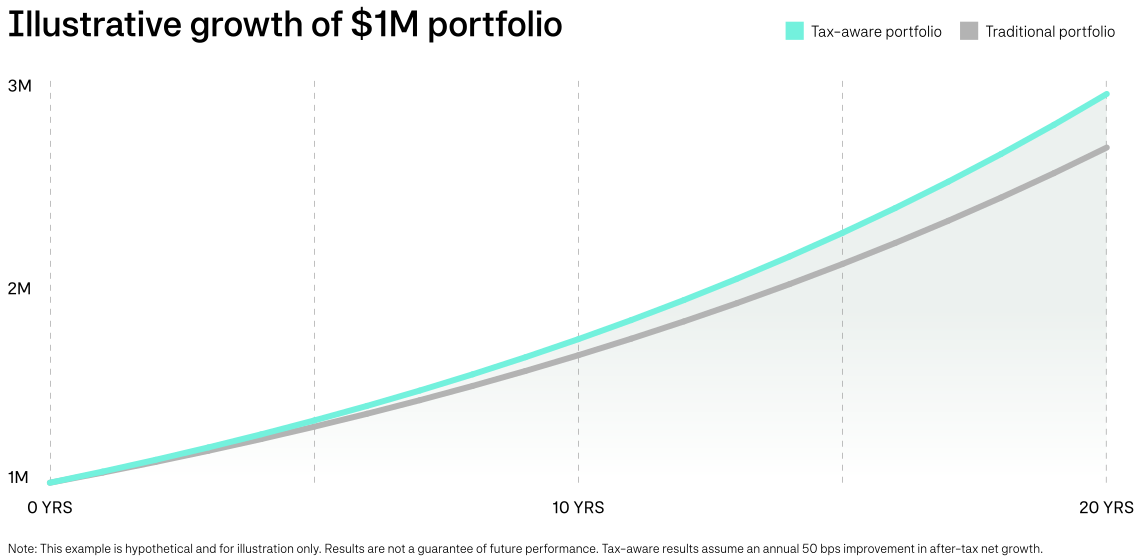
Assumptions:
- Starting portfolio: $1,000,000
- Traditional portfolio: 5% annual net growth
- Tax-aware portfolio: 5.5% annual net growth
- Tax alpha: 50 bps annually
- Time horizon: 20 years
What the chart shows:
Using those assumptions, the tax-aware approach ends at approximately $2.93 million versus about $2.67 million for the traditional approach, an estimated value add of about $264,460 over 20 years.
Additional considerations
While the basic framework is straightforward, effective asset placement also involves:
- Rebalancing strategy: Rebalancing within tax-deferred accounts (like IRAs) avoids triggering capital gains taxes, making them an ideal place for portfolio adjustments.
- Time horizon: Taxable accounts benefit from long holding periods, where gains can qualify for lower long-term capital gains rates. Frequent trading reduces this advantage.
- Estate planning: Assets in taxable accounts may receive a step-up in basis at death, potentially eliminating capital gains taxes for heirs — another reason to hold appreciated equities outside of retirement accounts.
- Roth versus traditional accounts:
- Roth IRA: Best for high-growth assets (to maximize tax-free growth)
- Traditional IRA/401(k): Better suited for income-generating, tax-inefficient investments
Common mistakes to avoid
- Holding high-yield bonds or REITs in taxable accounts
- Filling retirement accounts exclusively with equities
- Holding international funds (with foreign withholding) in retirement accounts
- Purchasing an annuity with IRA funds
- Ignoring tax consequences when rebalancing
- Holding tax-exempt investments (like municipal bonds) in tax-sheltered accounts
- Treating each account independently rather than as part of a unified portfolio
Final thoughts
Asset placement doesn’t require predicting markets or picking winning securities. Instead, it leverages tax efficiency to enhance outcomes. For investors willing to take a holistic view of their portfolio across all accounts, this strategy can deliver a meaningful edge — a form of “free return” earned through smarter structuring, not greater risk.
In a world where investment returns can be uncertain, controlling taxes is one of the few levers firmly within an investor’s grasp.
Everyone’s financial situation is unique. A thoughtful investment strategy should consider your overall portfolio, including your risk appetite, goals, time horizon and tax situation. Sikich’s team of tax and wealth management advisors can help you and your family on your specific needs.
About our authors
Sean R. O’Connell, CPA/PFS, CGMA, MST, is a Tax Principal with over 40 years of experience advising closely held businesses and their owners on tax, strategic and financial planning. He specializes in tax opportunities for middle-market companies, estate planning and wealth building. Sean.r.oconnell@sikich.com
Wesley Whamond, CFP, MBA, is a Financial Advisor with over 20 years of experience in the financial services industry. He has a passion for partnering with clients to navigate the financial world. In his role, he takes an encompassing, goals-based approach to tailor solutions to the needs of his clients. He has in-depth expertise in financial planning, investments, financial education and portfolio reviews, servicing clients of all backgrounds. Wesley.whamond@sikich.com
This publication contains general information only and Sikich is not, by means of this publication, rendering accounting, business, financial, investment, legal, tax, or any other professional advice or services. This publication is not a substitute for such professional advice or services, nor should you use it as a basis for any decision, action or omission that may affect you or your business. Before making any decision, taking any action or omitting an action that may affect you or your business, you should consult a qualified professional advisor. In addition, this publication may contain certain content generated by an artificial intelligence (AI) language model. You acknowledge that Sikich shall not be responsible for any loss sustained by you or any person who relies on this publication.