







A strong financial strategy outlasts macroeconomic factors, shocks, and other distractions outside of our control. Election cycles can create uncertainty and short-term market volatility, so let this be your reminder to stay focused on the long term. This involves deliberation on what is in your control. As 2026 comes to a close, now is the time to take advantage of year-end tax and investment planning opportunities.
What role does politics play in an investment portfolio?
Political ads, headlines and uncertainty have been difficult to escape ahead of the midterm elections. Whatever the outcome, political preferences should not drive investment decisions. The charts below show that the long-term trend has remained positive regardless of which party controls the White House or Congress.
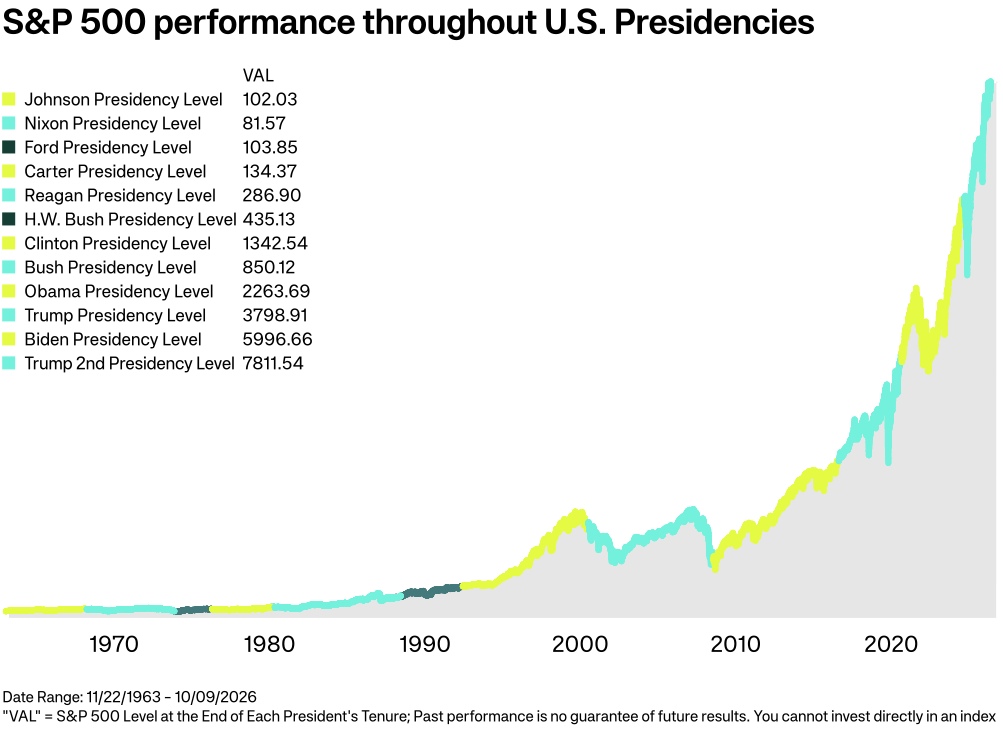
The first two charts below illustrate why long-term investing should transcend political preferences. The first shows S&P 500 performance by presidential term from President Johnson through President Trump. Of the 12 terms shown, 10 produced positive returns and only two produced declines.
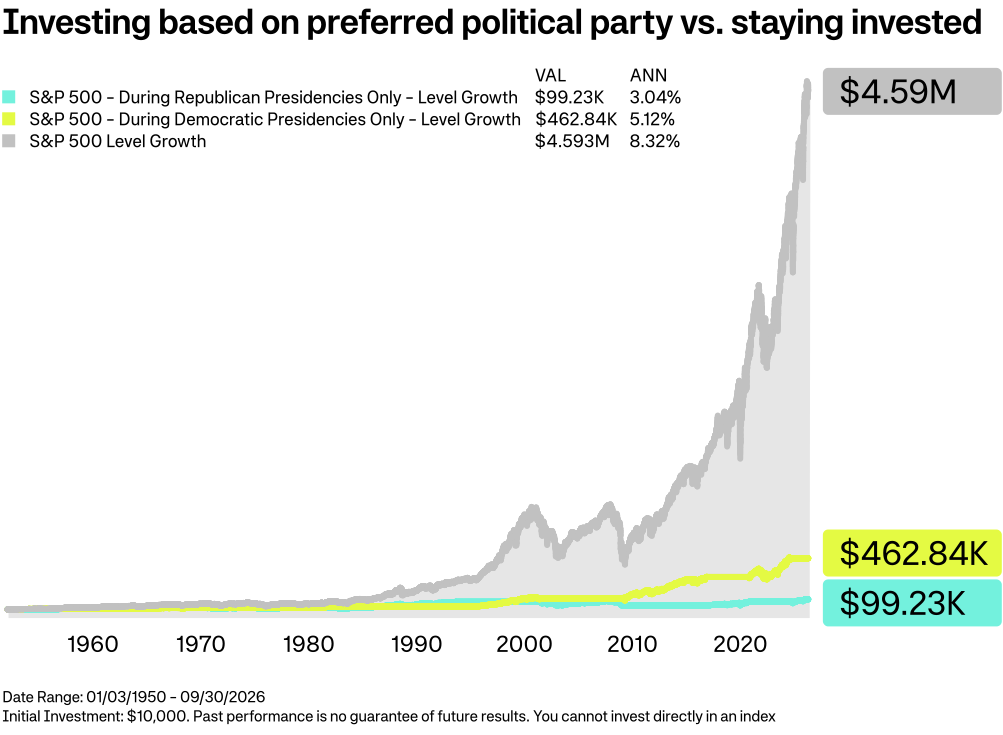
The second shows the hypothetical growth of $10,000 invested beginning in 1950 under three strategies: investing only during Democratic administrations, only during Republican administrations, or remaining invested regardless of which party held the White House. The first two strategies grew to $462,000 and $99,000, respectively. Staying invested throughout the full period produced an 8% annualized return and $4.6 million.
Politics can influence markets in the short term, but over the long term, staying invested has mattered far more than which party occupies the White House.
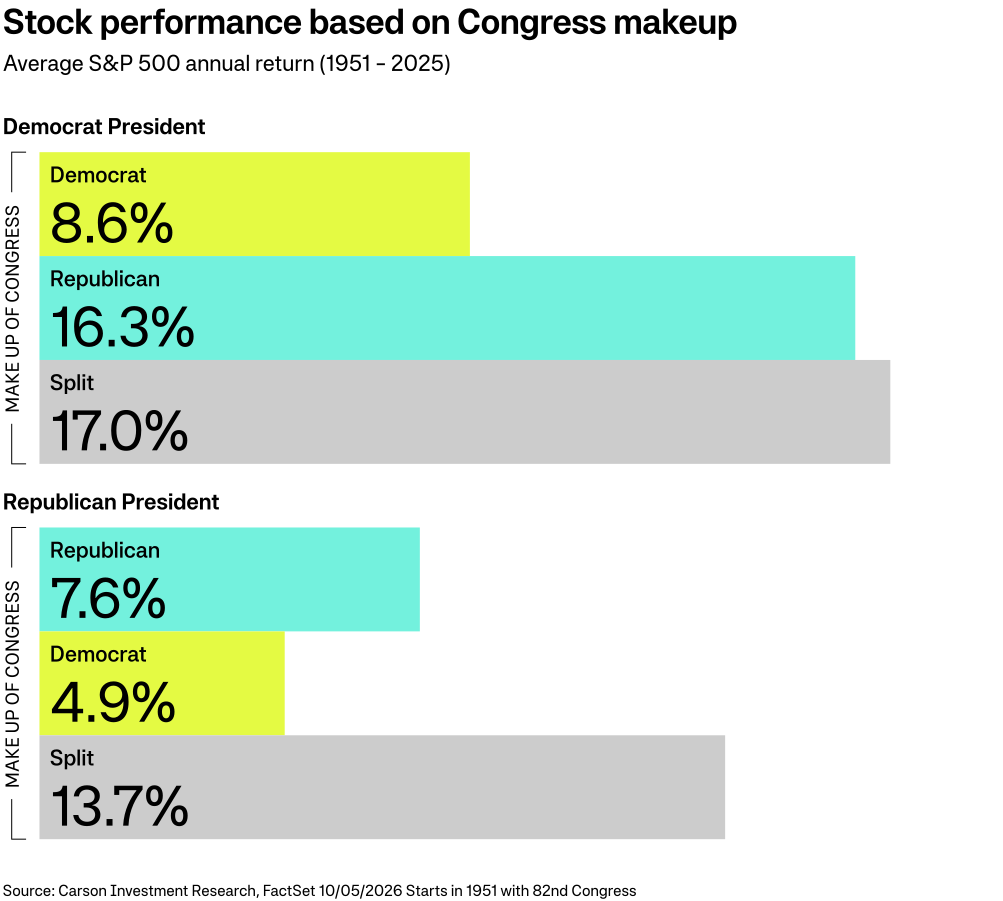
The final chart looks at S&P 500 performance under different combinations of presidential and congressional control. From 1951–2025, the market produced strong average returns under several political configurations. The highest occurred with a Democratic president and split Congress (17%), followed by a Democratic president and Republican-controlled Congress (16.3%) and a Republican president with split Congress (13.7%).
The broader point is that no single political configuration is necessary for strong market performance.
Takeaway: Don’t let politics drive your investment decisions. A disciplined, diversified strategy aligned with your financial goals can help you stay focused on the long term despite short-term political and market noise.
Need a financial plan that considers your full financial picture? Sikich’s wealth advisors can help you build one for you and your family.
End of year planning ideas
Now is a good time to review your financial plan and identify opportunities before year-end. Some decisions are time-sensitive, while others are simply worth revisiting as your financial circumstances evolve.
Coordinating with both your wealth advisor and tax advisor can help you evaluate these opportunities in the context of your broader financial picture.
Time sensitive considerations:
- Consider a Roth conversion: If your taxable income is lower than usual, converting a portion of a traditional IRA to a Roth IRA may be worth discussing with your tax and wealth advisors. A conversion could allow you to pay taxes on those assets now in exchange for tax-free qualified withdrawals in the future. Because Roth conversions must be completed by year-end to apply to that tax year, consider acting well before your custodian’s processing deadline.
- Review charitable giving: If charitable giving is part of your plan, consider whether cash, appreciated securities or a qualified charitable distribution (QCD) from an IRA is the most appropriate approach. Timing matters, particularly for QCDs, which must be made directly from the IRA to an eligible charitable organization and can count toward an applicable required minimum distribution (RMD).
- Take your RMD, if applicable: If you are subject to RMD rules, such as being over 73, make sure you have satisfied your distribution requirement for the year. RMD rules can also apply to inherited retirement accounts, although the requirements vary based on the beneficiary and circumstances. Because year-end processing takes time, don’t wait until the final days of December.
- Look for tax-loss harvesting opportunities: Losses in taxable investment accounts may provide an opportunity to offset realized capital gains. Review your portfolio before year-end to determine whether realizing losses makes sense within your broader investment and tax strategy.
- Review retirement savings: Evaluate how much you have contributed to your 401(k), IRA and other retirement accounts and whether you have room and the financial capacity to save more. Contribution limits and deadlines vary by account type, so review your options with your tax and wealth advisors.
Broader planning considerations:
- Review your investment plan: A lot can change in a year. Market performance may have shifted your portfolio away from its target allocation, while changes in your life may have affected your goals, risk tolerance or time horizon. Revisit the assumptions behind your investment strategy to make sure they still fit.
- Rebalance your portfolio: If your review shows that your portfolio has drifted from its target allocation, consider rebalancing to bring it back in line with your plan. You may also have excess cash that can be put to work. Rather than treating rebalancing as a once-a-year exercise, review your allocation periodically throughout the year.
- Review your estate plan: Confirm that your will, medical directives and, where appropriate, trust documents still reflect your wishes and circumstances. If it has been several years since your last review, or if you have experienced a significant life change, consider revisiting your plan with your estate planning attorney.
- Review your beneficiaries: Make sure the beneficiary designations on your retirement accounts remain current. The IRS notes that retirement plan and IRA beneficiaries are generally designated under the procedures established by the applicable account or plan. You may also want to review transfer-on-death or payable-on-death designations on eligible taxable investment and bank accounts as part of your broader estate plan.
About our authors
Andrew Paoni, MBA, CEPA, CFP®, CFA, specializes in portfolio management and financial planning, helping clients learn how to reach their personal financial goals. Andrew has deep experience as a financial advisor and assisting clients in spending and saving money efficiently so that they can enjoy a successful financial future. You can contact him at Andrew.Paoni@sikich.com.
Wesley Whamond, CFP, MBA, is a Financial Advisor with over 20 years of experience in the financial services industry. He has a passion for partnering with clients to navigate the financial world. In his role, he takes an encompassing, goals-based approach to tailor solutions to the needs of his clients. He has in-depth expertise in financial planning, investments, financial education and portfolio reviews, servicing clients of all backgrounds. Wesley.Whamond@sikich.com
To the extent that this material concerns tax matters, it is not intended or written to be used and cannot be used by a taxpayer for the purpose of avoiding penalties that may be imposed by law. Each taxpayer should seek independent advice from a tax professional based on his or her individual circumstances.
This publication contains general information only and Sikich is not, by means of this publication, rendering accounting, business, financial, investment, legal, tax, or any other professional advice or services. This publication is not a substitute for such professional advice or services, nor should you use it as a basis for any decision, action or omission that may affect you or your business. Before making any decision, taking any action or omitting an action that may affect you or your business, you should consult a qualified professional advisor. In addition, this publication may contain certain content generated by an artificial intelligence (AI) language model. You acknowledge that Sikich shall not be responsible for any loss sustained by you or any person who relies on this publication.