







The TrackWise on-premises end-of-life is not a technology event. It is a strategic forcing function, one that will separate life sciences organizations that use the moment to build a quality infrastructure for the next decade from those that simply replace a platform. For global pharma, BioTech, and medical device companies operating under increasing regulatory scrutiny, and for emerging BioTech and MedTech organizations building quality capability from the ground up, the decision made in response to this deadline will shape quality operations for years.
Three paths are available. The Deferrer (delayed action) accumulates compounding risk, the Migrator (lift & shift) achieves compliance continuity but inherits the same constraints in the cloud, and the Reimaginer takes this opportunity to rationalize processes, retire technical debt, and leapfrog into an AI-native quality architecture. The difference between migration and reimagination is a 40% or greater reduction in Cost of Quality, a 3X shift in quality team productivity, and the structural advantage of a quality system that improves continuously rather than depreciates.
This point of view is written for Quality Business, Digital Quality, and Data and AI leaders who recognize this moment for what it is and want a clear-eyed view of what the Reimaginer path actually requires, what it delivers, and how to get there. Sikich’s Life Sciences Quality Modernization practice brings together deep life sciences quality expertise, QMS platform implementation experience, and applied AI capability to guide organizations through this transition from initial assessment through autonomous quality operations.
A fork in the road: the path you choose reflects the future you envision
The TrackWise on-premises end-of-life is not optional. What is optional is how your organization responds to it. Regardless of company size, quality maturity, or available resources, virtually every EOL response falls into one of three behavioral archetypes shaped by business urgency, organizational readiness and the overall Quality vision and ambition.
- The Deferrer delays action due to competing priorities, unclear ownership, or lack of sponsorship. The system may still work, but each month of delay increases exposure, infrastructure cost, cybersecurity risk, and pressure to make a rushed decision. Deferrers often become forced Migrators, choosing the fastest available path rather than the best one.
- The Migrator prioritizes continuity: move off the legacy platform, achieve validated status, and minimize disruption. This path appears responsible but often carries technical debt forward. A time-bounded migration may be necessary under real constraints, but it should be a deliberate choice, not the default.
- The Reimaginer treats the EOL deadline as a mandate to modernize quality for the future. Reimaginers rationalize workflows, design the integration architecture, and select platforms based on AI roadmap maturity. Success is measured by quality outcomes such as CAPA cycle time, Cost of Quality, and inspection readiness.
What you are actually choosing
Quality and IT leaders must make deliberate choices that position the organization for long-term success. The Deferrer and Migrator paths typically face the least organizational resistance, while the Reimaginer path requires strong executive sponsorship. By using the EOL deadline as a catalyst, organizations can leverage the Reimaginer approach to accelerate their transition to a NextGen Quality platform.
The real cost of playing it safe
The TrackWise EOL has a hard deadline, but the consequences of inaction or inadequate action arrive well before it. And for those who believe a like-for-like cloud migration resolves the problem, math tells a different story.
The deferral tax
Every quarter on unsupported infrastructure compounds risk across four dimensions simultaneously.
- Cybersecurity and regulatory exposure grow in lockstep
- Infrastructure costs escalate
- Analytics paralysis deepens
- The support burden compounds quietly.
The migration trap
A direct cloud migration addresses the EOL deadline, not the architecture problem. Most migration business cases understate the risk of carrying forward years of custom workflows, validation packages, and point-to-point integrations. Organizations either migrate that debt and recreate the same ceiling in the cloud, or rationalize it, which is effectively a reimplementation and should be designed for the future from the start.
Like-for-like migration typically recovers 10–15% of quality operating cost, while a reimagined AI-integrated QMS can target 40% or more. That gap is the migration trap: meeting the compliance deadline while leaving the largest productivity gains untouched.
The reimaginer’s blueprint: what an AI-native quality system actually looks like
The Reimaginer begins with a question: what would quality operations look like if we designed them today, for the next decade, without the constraints we inherited? The answer is an architecture built on three interlocking capabilities: autonomous quality agents, a connected Digital Quality Thread, and an integration model that makes the eQMS the intelligence hub of the enterprise and not an isolated system of record.
Autonomous quality agents
An AI-native QMS does more than automate tasks; it reasons, prioritizes, and acts across quality processes. Key agent classes include:
- CAPA Orchestration identifies root causes at scale;
- Deviation Triage classifies events by risk and urgency in minutes;
- Supplier Risk Intelligence continuously recalibrates supplier risk scores;
- Audit Readiness maintains perpetual inspection preparedness;
- Document Intelligence accelerates authoring and change impact assessment.
Together, these agents move quality from reactive to anticipatory, shifting professionals from maintaining the system to directing it.
The digital quality thread
The QMS’s value compounds when quality data flows continuously across the product lifecycle. Five connected streams enable this:
- Design-to-Quality connects design controls to manufacturing quality plans;
- Supplier-to-Manufacturing triggers risk assessment from supplier deviations;
- Manufacturing-to-Release creates real-time lot readiness signals;
- Release-to-Post-Market preserves lot-to-field data lineage; and Post-Market-to-Design feeds surveillance insights into future products.
The result is a QMS that informs what happens next, not just records what happened.
The QMS as intelligence hub
Most organizations have integrated MES, ERP, PLM, LIMS, eTMF, and LMS, but few make sense of quality signals in real time and at scale. An AI-native QMS becomes the enterprise reasoning layer, contextualizing data and surfacing decisions, not just reports. The result is a quality function that sees more, responds faster, and continuously improves.
Making the leap: a practical path from where you are to where you need to be
Integrated, proactive, and autonomous quality operations are achievable when modernization is treated as a quality capability transformation, not just a technology implementation.
Know where you stand: the quality maturity continuum
Effective transformation begins with an honest assessment of current state. Quality operations across life sciences generally fall along a four-level continuum (inspired by BioPharma Digital Plant Maturity Model V3 (DPMM®)):
- Level 1 — Reactive. Quality is event driven, data lives in siloed systems and most decisions rely on institutional knowledge. Most of the organization’s quality capacity is consumed by reactive response.
- Level 2 — Managed. Processes are documented, metrics are reviewed periodically, and visibility is improving, but quality data remains largely retrospective and automation is limited to routing and notifications.
- Level 3 — Proactive. Quality teams anticipate risk through predictive analytics, integrated data, and real-time KPIs, applying human judgment to decisions rather than data aggregation.
- Level 4 — Autonomous. Agentic AI continuously triages, prioritizes, drafts, and escalates across quality processes, with human oversight at key decision gates. Quality professionals focus on strategy and exceptions while the system manages operations.
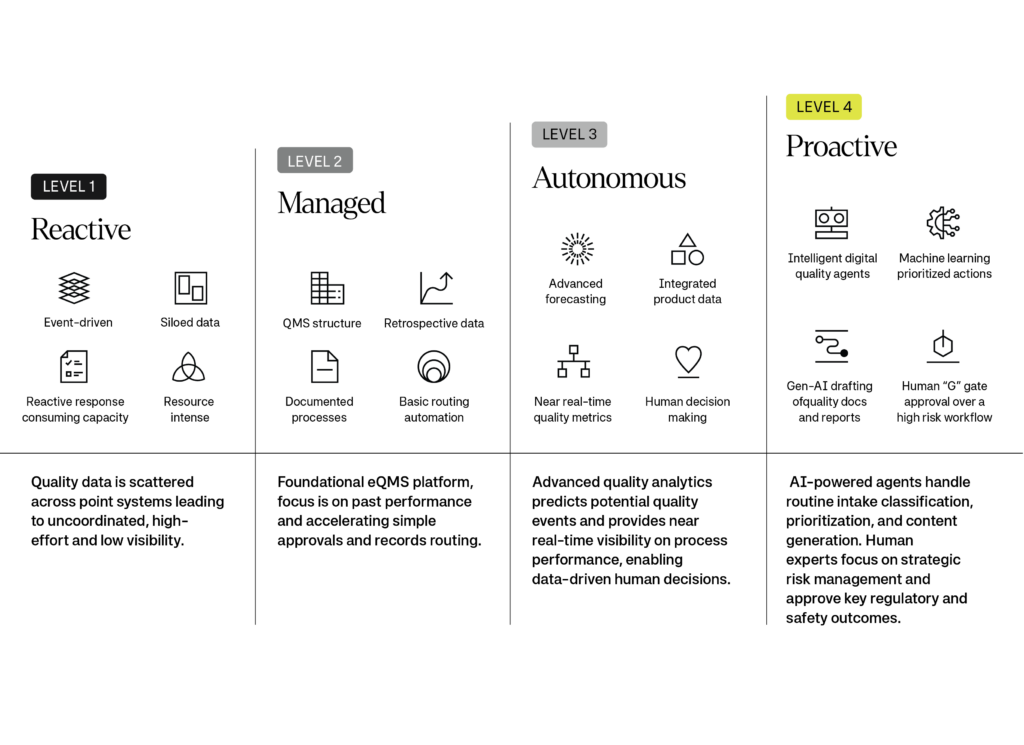
TrackWise EOL creates urgency, but the destination matters. A maturity assessment establishes the current-state baseline and informs a focused future-state roadmap. Organizations can then make deliberate choices about which quality capabilities should remain at Levels 1 or 2 and where advancing to Levels 3 or 4 will create the greatest strategic differentiation and business value.
The path is clear: organizations that capture the advantage choose to reimagine quality, not just replace a platform.
The value case: what “getting this right” is actually worth
The strategic argument for reimagination is clear. The financial argument is equally compelling and more concrete than most organizations expect when they begin modeling it.
The 3× productivity equation
Based on our value-stream analysis across clients, quality teams often spend 60-70% of their time on non-value-added activities such as deviation documentation, supplier audit scheduling, document routing, and audit preparation. This is a system design problem, not a people problem.
An AI-native QMS shifts routine work to agents, with humans reviewing outputs, making decisions, and managing exceptions. That is the basis of the 3× productivity claim: the same team produces more quality output because people become the decision layer, not the operating system.
Reimagining Cost of Quality
Cost of Quality (COQ) is the strongest financial lens for this transformation, yet it is often underused in modernization business cases. COQ includes prevention costs, appraisal costs, and failure costs such as rework, recalls, regulatory penalties, and revenue lost to delays.
In reactive organizations, failure costs dominate. Benchmarks often show failure costs representing 50–70% of total COQ at maturity Level 1 or 2, while prevention investments are underweighted because they are harder to measure and easier to defer.
A reimagined architecture shifts cost from failure to prevention by making prevention continuous and effortless. Agents monitor deviation signals, supplier risk, and process performance without requiring added resources. The value is measurable. For an organization with $50M in annual COQ, a 40% reduction represents $20M in annual value and $100M over five years, typically far exceeding the required program investment.
Beyond productivity gains and cost of quality improvement, quality as a strategic value creator
Speed to market: AI-assisted deviation closure, faster CAPA resolution, and continuous audit readiness compress quality timelines and accelerate development velocity.
Regulatory agility: Real-time gap analysis, perpetual audit readiness, and living regulatory intelligence help organizations respond faster to guidance, agency requests, and inspections with less disruption.
Talent leverage: AI-native quality environments shift professionals from manual documentation to higher-value work such as supplier development, risk-based decision-making, and regulatory strategy, strengthening both productivity and talent retention.
A fundamental shift in Cost of Quality and Quality as a strategic enabler to enterprise outcomes
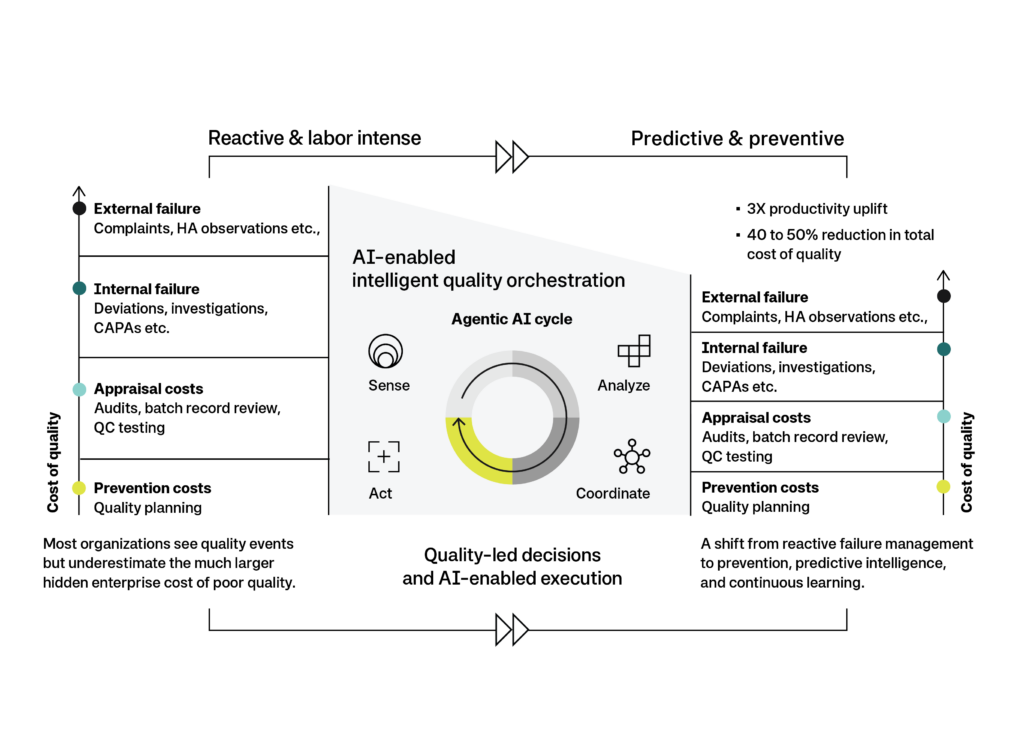
The cost of waiting
Deferrers face rising infrastructure costs, regulatory exposure, and analytics gaps, while early modernizers compound productivity gains and quality data advantages. The gap widens each year as AI-native systems improve with use and deferred on-prem systems depreciate.
Migrators pay the transformation cost but capture only partial value, leaving larger gains for a future program made harder by refreshed technical debt.
Getting this right creates more than ROI; it creates compounding advantage from making the right architectural decision at the right moment. The financial case is grounded in observable quality economics. The value is there; the question is who captures it first.
Where to begin and how Sikich can help
Every organization faces the same TrackWise EOL deadline from a different starting point. The right first move is not platform selection or program kickoff, but an honest assessment of current maturity and the best path forward.
Sikich has developed two tools specifically for organizations navigating the TrackWise EOL transition.
TrackWise EOL Risk & Transformation Assessment
The EOL Assessment is a structured diagnostic that gives your quality and technology leadership a clear picture across three dimensions: your current risk exposure, transformation opportunity, and a recommended archetype “Deferrer, Migrator, or Reimaginer” calibrated to your organization’s size, regulatory footprint, and strategic priorities.
Request the TrackWise EOL Risk & Transformation Assessment
eQMS Platform Assessment Kit
The eQMS Platform Assessment Kit provides a structured evaluation framework to assess eQMS platforms across all key functional and technical dimensions including native AI and agentic capability, and total cost of ownership.
The kit includes a scored evaluation template, a vendor capability reference guide, and guidance on how to structure vendor demonstrations to surface the questions that matter most for your transformation objectives.
Request the eQMS Platform Assessment Kit
How Sikich can help
Sikich’s Life Sciences Quality Modernization practice brings together three capabilities that this transformation requires in combination.
Life sciences quality expertise
Our quality consulting team brings deep experience across global pharma, BioTech, and medical device organizations, spanning QMS vision and strategy, business process design, eQMS platform assessment, business case development, and transformation roadmaps.
QMS platform and implementation
We have implemented and migrated multiple eQMS platforms from legacy on-premise environments to cloud-based QMS platforms across R&D and commercial quality. We rationalize legacy customizations, architect the integration layer, and deliver GxP-validated go-lives with confidence.
Data and AI
Our applied AI practice brings data architecture, agentic AI deployment, and quality intelligence capabilities to transform quality operations. We help organizations deploy quality agents in regulated environments and establish governance frameworks that keep human oversight appropriately in the loop.
Conclusion
TrackWise EOL gives every life sciences organization a rare and time-bound choice. The organizations that use this moment to reimagine and not just replace will spend the next decade leading. Those that don’t will spend it catching up.
Co-Author: Anand Shukla
Anand Shukla is a Principal in charge of the Quality Management Systems (QMS) practice at Sikich, a leading technology professional services organization. With over 15 years of experience in quality assurance, regulatory compliance, and operational excellence, Anand specializes in designing and implementing scalable QMS frameworks that align with industry standards. He is passionate about helping clients drive continuous improvement, mitigate risk, and achieve long-term quality objectives through digital transformation and best-in-class quality practices.
This publication contains general information only and Sikich is not, by means of this publication, rendering accounting, business, financial, investment, legal, tax, or any other professional advice or services. This publication is not a substitute for such professional advice or services, nor should you use it as a basis for any decision, action or omission that may affect you or your business. Before making any decision, taking any action or omitting an action that may affect you or your business, you should consult a qualified professional advisor. In addition, this publication may contain certain content generated by an artificial intelligence (AI) language model. You acknowledge that Sikich shall not be responsible for any loss sustained by you or any person who relies on this publication.