







Artificial intelligence (AI) continues to expand across the NetSuite platform, and the 2026.1 release introduces several features embedded directly into everyday processes.
Rather than sitting off to the side as a separate tool, AI is being woven into financial reporting, close management, forecasting, and transaction entry. The shift is subtle, but it changes how teams interact with the system over time.
We reviewed the release and pulled out the AI capabilities that deliver the most practical value to teams in their day-to-day work. Below are the features worth paying attention to, along with where they can make a difference and where expectations should remain grounded.
Narrative Insights
The Narrative Insights feature changes how teams consume reports. Instead of scanning rows of data and building context manually, users can generate a written summary that highlights trends, anomalies, risks, and opportunities tied to what they are viewing.
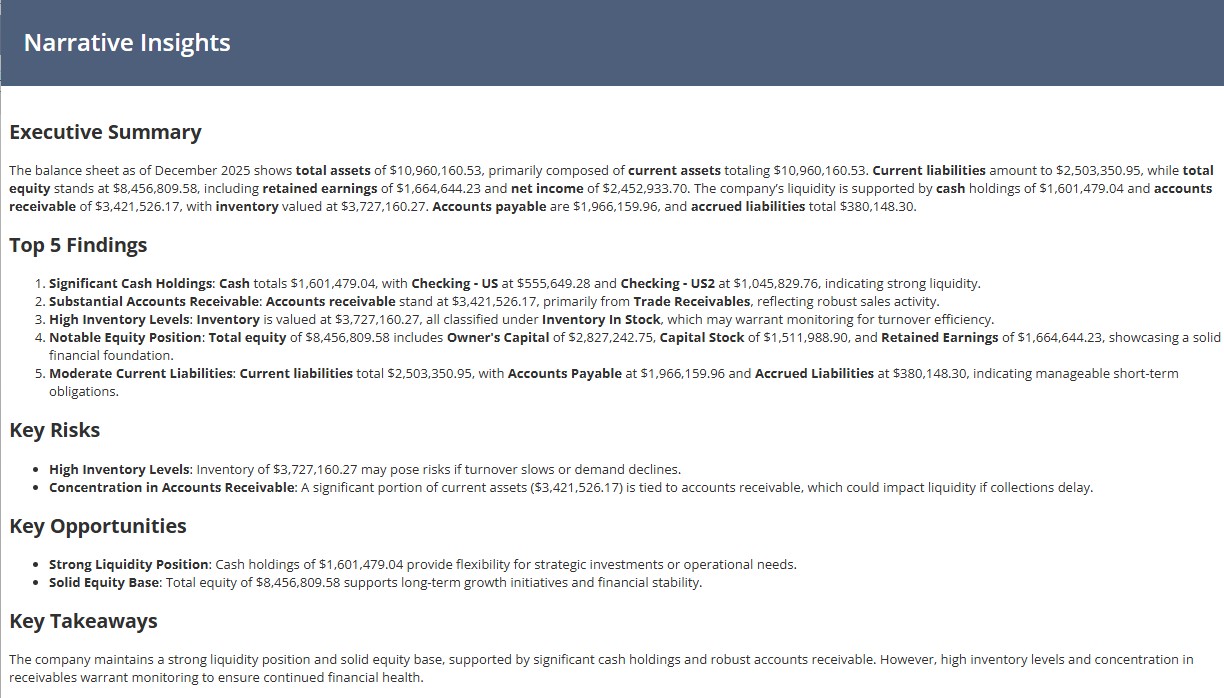
In this example, NetSuite produces an executive summary alongside key findings and flagged risks, giving teams a structured interpretation of the data without requiring them to build it from scratch.
Generating these summaries can save time, especially for leadership teams who want a quick read on performance. At the same time, the summary reflects patterns in the data, not the full story behind it. Context still lives outside the system, and that layer does not disappear. So, teams should treat this as a starting point for analysis, not the conclusion.
Intelligent Close Manager
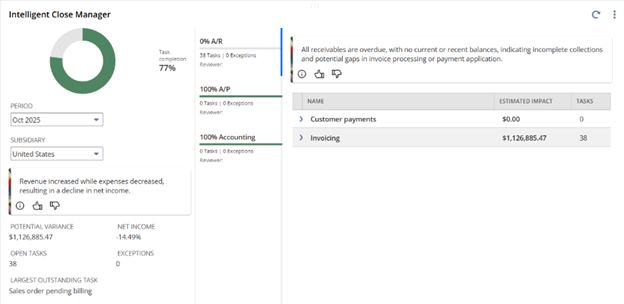
The Intelligent Close Manager Dashboard Portlet introduces AI into the financial close process by consolidating tasks, transaction activity, and potential exceptions into a single, centralized view across areas such as AR and AP.
Instead of discovering issues late in the close, teams can see where activity is missing, where variances are forming, and where attention is needed earlier in the process.
Within that view, teams can:
- Monitor outstanding tasks and exceptions
- Identify expected missing transactions
- Highlight potential variances
- Automatically generate tasks based on activity
Bringing this level of visibility into the close does not automate the process or remove the need for coordination between teams. What it changes is how early teams can see issues forming, which in most close cycles determines how quickly they can act.
Payment Date Prediction
Payment Date Prediction uses AI to estimate when customers are likely to pay open invoices based on historical payment behavior. NetSuite displays these predictions directly on invoice records, adding forward-looking insight without requiring separate analysis.
Each prediction includes:
- Predicted Payment Date – reflects expected payment timing
- Predicted Overdue Days – estimates how late a payment may be
NetSuite refreshes these predictions periodically, allowing teams to adjust expectations as new data becomes available.
Teams managing a high volume of receivables can use this to support more informed cash flow forecasting and collections planning. These outputs remain directional. Changes in customer behavior or external factors can impact accuracy, so teams should treat them as guidance rather than certainty.
Intelligent Item Recommendations
Intelligent Item Recommendations use AI to surface cross-sell and upsell opportunities within NetSuite transactions, drawing on historical purchasing patterns to suggest products customers are likely to buy alongside items already being quoted or ordered.
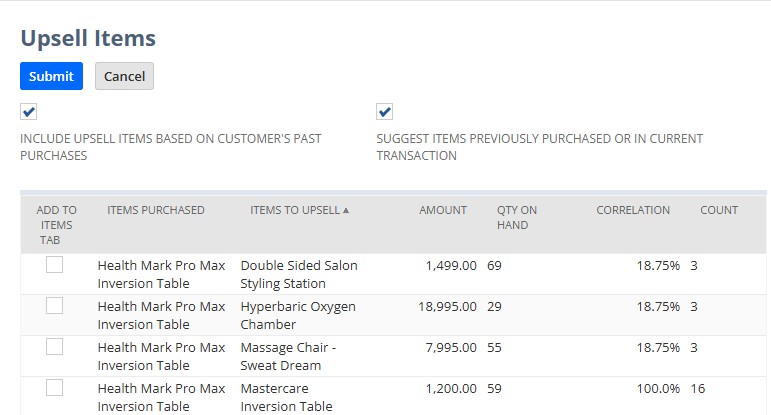
These recommendations appear directly within the transaction, showing related items, correlation, and purchase patterns in real time.
They are typically based on:
- Items frequently purchased together
- Customer purchase history
- Buying patterns from similar customers
Opportunities surface at the moment they matter most, but they are still shaped by past behavior. When purchasing patterns are inconsistent or limited, the recommendations tend to follow that same pattern. Teams should use this as guidance, not as a substitute for understanding the customer.
NetSuite CPQ AI Assistant
Configuration often introduces complexity into the sales process. The CPQ AI Assistant guides users through that process with a conversational interface that walks through options, inputs, and recommendations.
This reduces the effort required to navigate complex configurations and creates more consistency in how teams build them.
Even so, edge cases still exist. More complex or highly customized scenarios still require review. The assistant simplifies the process, but it does not replace the need to understand the outcome.
Next steps
The NetSuite 2026.1 New Release shows how AI is becoming part of how teams use the system day to day.
That shift brings real advantages, but it does not change the fundamentals. Output still depends on how data is structured, how processes are followed, and how consistently the system is used. AI can make information easier to access and quicker to interpret, but it does not replace the thinking behind it.
Teams that see the most value are not starting with AI. They are starting with how their system already operates and where structure, consistency, and visibility can be strengthened.
If you are evaluating how these AI features fit into your current NetSuite, begin with how your teams work today. From there, it becomes easier to identify where AI fits naturally and where it may require more structure to deliver value.
Connect with our team to walk through these features in more detail and explore how they fit within your current NetSuite.
This publication contains general information only and Sikich is not, by means of this publication, rendering accounting, business, financial, investment, legal, tax, or any other professional advice or services. This publication is not a substitute for such professional advice or services, nor should you use it as a basis for any decision, action or omission that may affect you or your business. Before making any decision, taking any action or omitting an action that may affect you or your business, you should consult a qualified professional advisor. In addition, this publication may contain certain content generated by an artificial intelligence (AI) language model. You acknowledge that Sikich shall not be responsible for any loss sustained by you or any person who relies on this publication.