







Having an effective AI governance plan is a crucial piece of the puzzle for achieving a smart, safe and successful implementation of any AI tool in a business.
But data governance is just as important. Some leaders mistakenly assume that AI governance can supplant or replace data governance. But it’s not a question of one or the other; you need both because they solve fundamentally different problems.
AI governance and data governance are two sides of the same coin. Data governance protects the integrity of the inputs that AI depends on to produce reliable results. After all, one of the oldest and most foundational ideas in computing is “garbage in, garbage out.” Quality output depends on quality input, just as you can’t build a healthy body without good nutrition, or a house that will stand up to wind, rain, and the occasional big bad wolf if you construct it out of flimsy materials.
Let’s look at why data governance and AI governance need to go hand in hand, and how the biggest payoffs come from addressing them in a coordinated way.
Why governance is top of mind
Companies face many challenges as they move toward AI implementation and adoption:
- Rapid technological change: AI technology is advancing faster than many organizations and regulators can keep up.
- Skills and knowledge gaps: Roles responsible for governance, such as auditors or security teams, often need to quickly and continuously learn new AI concepts to oversee these systems.
- Security concerns: Many organizations worry about whether AI tools might expose sensitive data.
- Decision accuracy: Companies also worry about whether AI-generated recommendations will be accurate and reliable.
- Business value: Executives frequently ask whether AI investments will deliver meaningful returns.
The good news is that proper governance can assuage these concerns and create a smoother path.
Many organizations have fallen into a pattern of overlooking or ignoring data governance, but AI initiatives are forcing them to revisit it. That’s partly because the topic of AI governance is drawing attention from internal auditors, in addition to boards.
These discussions generally wind up revealing gaps in how organizations are managing their data, and that in turn leads to a lightbulb moment as they realize they need strong data governance to get the most out of AI.
Let’s start with a look at the role of each:
What data governance does
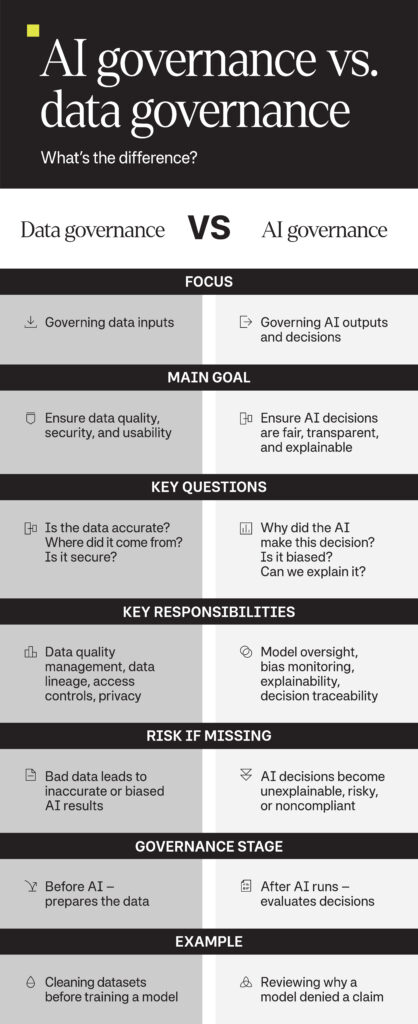
Data governance consists of the policies and procedures that govern the inputs, determining how organizations go about assessing, managing and safeguarding the data that’s going to inform their systems and processes.
This is critical because AI models rely on data to learn and make decisions. AI systems can’t distinguish between correct and incorrect information; they simply process what they receive. If you provide them with poor-quality information, you’re likely to get misleading results.
An effective data governance plan includes:
- Ensuring the accuracy and quality of data
- Managing how data flows through the organization
- Making sure that sensitive information is secure
- Tracking where data comes from and how it’s used
- Determining what data can or can’t be used
These steps are essential because without them AI systems can wind up relying on incomplete, incorrect or unauthorized data. Missing data creates hidden bias within AI systems, while incorrect data can produce inaccurate recommendations.
Data governance shields against those dangers by making sure that the data that feeds into analytics and AI systems is dependable and appropriate.
What AI governance is responsible for
By contrast, AI governance focuses on a later stage in the process, governing the outputs as opposed to the inputs. Its concerns include:
- Understanding how AI systems make decisions
- Evaluating whether those decisions are fair and unbiased
- Ensuring the transparency of AI outputs
- Making sure AI decisions are traceable
- Providing the ability to explain how a model reached a particular result
These tasks become easier when the data that informs AI decisions has been properly managed. It makes it easier to diagnose and address issues with AI when teams can be confident that they’re not the result of flawed or faulty inputs.
Early days: the role of AI governance is still evolving
The reality is that many companies are still figuring out how to manage AI governance. Because it’s a rapidly evolving technology, that’s not surprising.
Some organizations have no framework in place at all. Others may have partial policies or scattered controls that don’t fully meet their needs.
We’ve seen only a small number of businesses with fully operational AI governance programs embedded into their strategy. Most organizations are still learning how to evaluate the risks of AI, monitor AI outputs and manage transparency while making sure that decisions are explainable.
The good news is that getting ahead of the curve on governance at this early stage can give your business a valuable advantage, positioning you to move faster and more confidently through the opportunities and challenges that will shape the road ahead.
How AI governance and data governance work together
Ideally, the two halves should function as a seamless whole, with data governance serving as the foundation for AI governance. Effective data governance sets you up to provide the vetted and verified information that AI needs to proceed with confidence, like a doctor handing off a patient’s chart to a specialist or surgeon. The more reliable the data, the better the prospects.
On the flip side, without strong data governance in place, AI governance becomes harder to enforce. Protecting the quality of the data inputs that feed into AI systems is like making sure you’re putting good-quality gas in your tank, to protect you from trouble down the road.
Our approach to data and AI emphasizes the close connection between the two forms of governance. Understanding this makes it possible to answer important questions:
- Why did the AI tool make this decision?
- Was the decision based on biased or incomplete data?
- Can the organization explain or audit the outcome?
The role of governance: it’s an enabler, not a barrier
A common misconception is that governance slows innovation.
On the contrary, good governance helps businesses avoid the pitfalls that create resistance, slow down momentum and waste time on problems that could have been avoided in the first place.
Governance protects progress, putting guardrails in place that allow teams to move forward with greater confidence while taking friction out of the equation. Governance also helps organizations safely adopt AI, limiting liability by making sure that that data and AI are used responsibly.
A useful way to think about the role of governance is that it removes obstacles. It helps businesses “get to yes” by enabling safe use of both data and AI, while managing risk responsibly.
Building governance into strategy
Successful governance programs start with business strategy. Instead of adding governance as an afterthought, the most productive approach is to build it into your business as early as possible.
Organizations should:
- Define their strategic goals
- Determine how data and AI support those goals
- Build governance frameworks aligned with those objectives
- Establish clear operating models and responsibilities
- Implement appropriate processes, policies and oversight mechanisms
Well-framed governance programs may include any or all of the following:
- Policies and operating models
- Organizational roles and responsibilities
- Oversight committees
- Tools for tracking data lineage and AI outputs
- Processes for approvals and decision tracing
- Monitoring and audit procedures
Governance: the foundation for success
Among the most common questions that we hear organizations raising about governance are:
- Security: Is our data safe when using AI systems?
- Accuracy: Can we trust AI-generated decisions?
- Business value: Are we getting meaningful results from AI investments?
These concerns demonstrate and reinforce the need for structured governance around data and AI. A thoughtful and well-executed approach to governance creates not only peace of mind but a springboard for reaching higher goals, with better aim and momentum.
Organizations that rise to the challenge will be better positioned to manage risk, maintain trust and unlock the full value of AI.
Ready to find out more about how Sikich can help your business get the most out of AI systems and tools?
Get in touch with our data and AI team to start a conversation.

This publication contains general information only and Sikich is not, by means of this publication, rendering accounting, business, financial, investment, legal, tax, or any other professional advice or services. This publication is not a substitute for such professional advice or services, nor should you use it as a basis for any decision, action or omission that may affect you or your business. Before making any decision, taking any action or omitting an action that may affect you or your business, you should consult a qualified professional advisor. In addition, this publication may contain certain content generated by an artificial intelligence (AI) language model. You acknowledge that Sikich shall not be responsible for any loss sustained by you or any person who relies on this publication.