







As organizations grow, so does the volume of data generated by Microsoft Dynamics 365 Finance & Supply Chain Management (D365 F&SCM). Historically, while entitlements were documented in the Dynamics Licensing Guide, storage was seen as an infinite resource as Microsoft lacked the tools to manage and measure storage, but with the transition to the Power Platform Admin Center, that is changing. This means that exceeding your licensed capacity management in Dynamics 365 can block critical actions, such as deploying new environments (Unified Development or Sandboxes Environments, UDE & USE). To aid in managing your storage and defining a path to sustain growth without unexpected storage bills, Sikich has developed the Capacity Review Workshop for D365 F&SCM. The workshop will help organizations:
- Understand & Review Storage Entitlements: Use the Power Platform Admin Center to monitor your storage entitlements and consumption across D365 F&SCM and Dataverse environments. Entitlements are based on user and sandbox licensing, so understanding your allocation is crucial.
- Monitor Consumption: Analyze capacity by environment and table. Leverage built-in cleanup routines for log tables and set appropriate retention policies to keep your database lean.
- Manage Sandbox Storage: Regularly purge unnecessary data from sandbox and development environments to avoid unexpected overage costs.
- Define an Archival Strategy: Review available archival tools, costs and benefits of different archiving approaches.
Archiving Strategies: Out-of-the-Box vs. Advanced Solutions
Out of the box, D365 F&SCM offers a few tools to help reduce database size. These fall in two categories: clean up and archive.
Clean up utilities are periodic tasks that run and delete data older than a certain number of days. Common examples include batch history (table BATCHHISTORY), document history (table DOCUHISTORY) and notification history (EVENTCUD). When analyzing data across our client base, we commonly see these tables in the top 20 tables by size.
Microsoft also provides native archiving tools that move historical, inactive data from D365 F&SCM to Dataverse long term retention. This helps reduce database size and improve performance. Supported datasets include General Ledger, Tax Transactions, Inventory Transactions, Inventory Journals, and Sales Orders. This toolset has a few limitations, however, including the following:
- Only a subset of tables are supported.
- Relies on Dataverse storage, which may incur additional licensing costs.
- Extensions are required for custom fields.
- Purge capabilities are still in preview.
Introducing the Sikich Dynamics Archiving Service
To address these limitations, Sikich offers an alternate—the Dynamics Archiving Service:
- Archive Any Table: Archive and purge any table (including custom fields) without needing extensions.
- Flexible Storage: Export data to your own Azure Blob Storage, dramatically reducing costs (as low as $10/TB for cool storage).
- Predefined & Custom Datasets: Use predefined datasets for common business scenarios (e.g. inventory transactions) or define custom queries for bespoke archiving needs.
- Parquet Format: Data is stored in Parquet, an open-source columnar format compatible with all major analytics platforms (Fabric, Databricks, Snowflake, etc.).
Bringing it all Together and Unlock Analytics & AI with Microsoft Fabric
While one benefit of storing data in Azure Blob Storage is decoupling from your data & analytics tool, Sikich still recommends utilizing Microsoft Fabric. Why? Well, you’ll still need to use Fabric or Synapse Link to get live data out of D365 F&SCM.
Microsoft Fabric is a unified analytics platform that brings together data engineering, data science, real-time analytics, and business intelligence. For Dynamics 365 customers, consider this future state of data via Fabric’s transformative capabilities:
- Near Real-Time Data Replication: Fabric Link for Dynamics 365 F&SCM enables near real-time replication of operational data into Microsoft Fabric, eliminating silos and enabling unified analytics.
- Archived Data: Combine near real-time data with archived data, saving on data storage whilst not losing on insights
- Legacy & Third-Party Data: Incorporate legacy ERP data with third part application data, such as Salesforce, and you have live, archived, legacy, and third-party data in one holistic data lake.
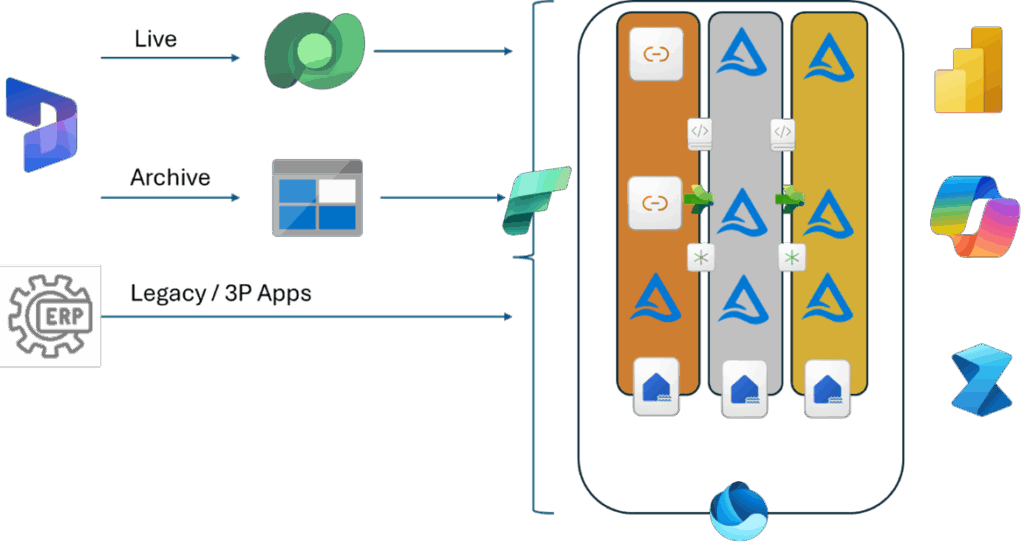
With our foundation of consolidated data, we can now unlock:
- AI and Copilot Integration: With all enterprise data in Fabric, Copilot and Azure AI can deliver deeper, contextual insights, automate decisions, and enable natural language queries across your business data.
- Self-Service BI: Power BI users can explore governed datasets in Fabric, build reports, and leverage Copilot for automated summaries and visualizations.
- Leverage Microsoft Purview to provide unified data governance, ensuring secure, role-based access to all data in Fabric.
A Modern Approach to Data Lifecycle Management
Effective capacity management, robust archiving, and advanced analytics are essential for maximizing the value of Dynamics 365 F&SCM. By combining Microsoft’s native tools with advanced solutions like Sikich’s Dynamics Archiving Service and leveraging Microsoft Fabric, organizations can:
- Avoid unexpected storage costs and performance issues.
- Retain and govern valuable historical data.
- Unlock powerful insights and AI-driven automation.
Ready to transform your Dynamics 365 data strategy? Explore how Sikich and Microsoft Fabric can help you unify, govern, and activate your enterprise data for smarter decisions and future-ready operations.
This publication contains general information only and Sikich is not, by means of this publication, rendering accounting, business, financial, investment, legal, tax, or any other professional advice or services. This publication is not a substitute for such professional advice or services, nor should you use it as a basis for any decision, action or omission that may affect you or your business. Before making any decision, taking any action or omitting an action that may affect you or your business, you should consult a qualified professional advisor. In addition, this publication may contain certain content generated by an artificial intelligence (AI) language model. You acknowledge that Sikich shall not be responsible for any loss sustained by you or any person who relies on this publication.