







In a previous Sikich blog post, I spoke at a high level about the importance of staffing your ERP project team with the talent required to ensure project success. In this post, I’d like to drill down into that topic further and elaborate on the first task to be addressed for any project, which is to form a team.
Transformative projects require people with transformative mind sets and a passion for achieving a project’s vision. These are typically your best, brightest and most talented people. But even if you are fortunate enough to recruit the best and brightest to your team, their talent will be wasted unless 1) roles and responsibilities are properly defined, 2) a team structure is in place that aligns roles within functional and technical domains and 3) the team structure provides for accountability for key deliverables and enables success.
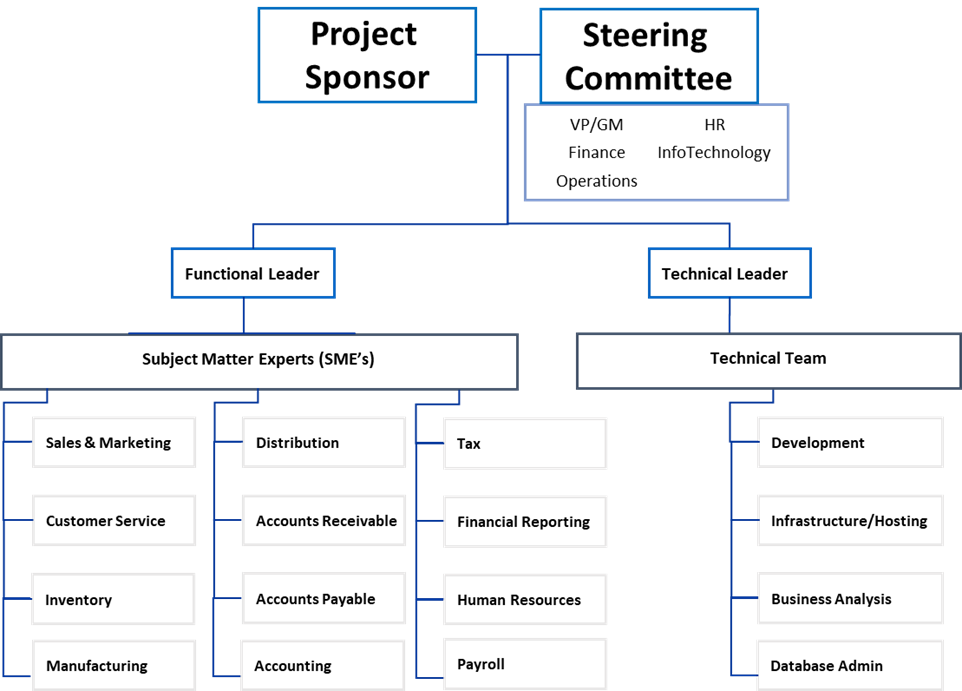
A picture is worth a thousand words, so in the interest of clarity I’ll start with a picture of an example of a team structure that has served me well on many large projects.
Example of an ERP Project Team Structure
Sponsorship/Steering Committee
Project sponsorship should come at the highest level of the organization and represent the major functional areas to be impacted by the ERP project. The Sponsor should be someone highly positioned and respected within the organization who has the most skin in the game relative to project outcomes. He/she should be the Chair of the Steering Committee and be best positioned to navigate the politics of funding and resolution of issues that will surely arise.
Functional and Technical Leaders
These are the day-to-day leaders of the project who have the clearest vision of desired project outcomes and are most critical to project success. Although separate individuals with distinct skills, they must think of themselves as both in the same “box” on the project org chart. They should be peers in terms of status within the organization and level of experience and accomplishment within their functional and technical spaces. They recognize joint accountability and are equally passionate about achieving project outcomes. In addition, they share the following responsibilities and competencies within and between their functional or technical domains:
- Overall vision and passion for what the project is meant to accomplish
- Overall responsibility for the functional and technical execution of the ERP Project
- Manage budget, schedule, resource conflicts, etc.
- Resolve issues/problems escalated by the individual team members
- Facilitate interactions between the core project team members and external stakeholders
- Enable/facilitate the performance of activities required to deliver the project
- Ensure all project teams and the activities are optimized to meet interim and final project goals
- Facilitate/chair meetings to enable decision making and communications
What should not be overlooked is that these must be full-time positions lasting for the duration of the project, including training and post-implementation support. People filling these roles must give up their “day jobs.” When undertaking a significant ERP project and transformation, the organizations talent pipeline and succession plan are critical to ensure the best talent is assigned to the project and that they can be confidently replaced in their current roles.
Functional and Technical Project Team Members
The Functional and Technical Teams consist of:
- Subject Matter Experts (SMEs) who own and understand current business processes across all functional areas, can envision change and can emerge as functional leaders when the new ERP system is deployed. SMEs are less likely than technical team members to be assigned full-time to the project and will likely retain their “day jobs.” But their ability to devote time to the project will be critical and time required will vary based on functional area and project scope.
- Business Analysts (BAs) who bring functional knowledge and industry best practices to understand how the ERP platform chosen can best be optimized to achieve business goals. Since an ERP implementation is most likely a one-off occurrence in your organization, BAs may include external consultants with knowledge of the ERP platform selected and who can bring experience and best practices from previous engagements.
- Technical Staff who design data and infrastructure components of the ERP platform. Depending on the ERP platform and hosting option chosen, Technical Staff could be a mix of internal staff, consultants, or cloud providers.
All team members should have the authority to implement business process changes and the confidence and ability to forcefully escalate proposed changes up the chain of command that have impact beyond their pay grade. They should have a strong inclination toward adopting best practices and a strong aversion to customizations. On a well-run project, who is part of the Functional Team vs. the Technical Team will become indistinguishable over time.
The biggest challenge in staffing an ERP project team is getting commitment of time and mindshare from internal staff, particularly SMEs, who are also critical to running day-to-day operations. Some things to consider when approaching this staffing challenge:
- Don’t sugarcoat the challenge. Set expectations before beginning the project and acknowledge that a time commitment will be required above and beyond day-to-day running of the business.
- Get concurrence from the SMEs’ functional management teams.
- Take the opportunity the project presents to eliminate or defer non-value-added tasks in day-to-day operations.
- Select team members that are open to adopting standard best practices and minimizing customization.
- Backfill critical SMEs with temps where feasible for routine tasks or activities that don’t rely on deep business or legacy knowledge.
- Help the SMEs’ functional teams plan by reflecting specific task and time expectations directly in the project plan, including tasks, hours, timing, and deliverables.
- Plan and anticipate peak time commitments required during Deploy, Refine, Validate, and Release phases.
- Choose SMEs who are change agents and will passionately commit to the goals of the project.
- Assess your talent pipeline and succession plan to determine who is ready to take on more responsibility in day-to-day roles.
There is no “silver bullet” that can solve the SME challenge. The best that can be done is to set reasonable expectations, have a plan with detailed tasks, assignments, and realistic time estimates, and anticipate the need to balance priorities.
The Project Manager
The Project Manager’s challenge is to collaborate with the Functional and Technical Teams to define tasks and workstreams, estimate effort, assign staff, monitor completion and escalate issues. He/she owns and manages the project plan in terms of cost and time and their relationship to scope. I’ve purposely not shown the Project Manager on the sample org chart above so as not to imply a hierarchy but to emphasize the Project Manager as a peer-level resource to the Functional and Technical Leaders. He/she does not merely “check the box” when tasks are completed but casts a continuous and mercilessly critical eye on project progress and escalates issues for action.
As Eisenhower said, plans are useless, but planning is essential. Essential to planning is having the right team members, the right ERP project team structure, and setting the right expectations.
This publication contains general information only and Sikich is not, by means of this publication, rendering accounting, business, financial, investment, legal, tax, or any other professional advice or services. This publication is not a substitute for such professional advice or services, nor should you use it as a basis for any decision, action or omission that may affect you or your business. Before making any decision, taking any action or omitting an action that may affect you or your business, you should consult a qualified professional advisor. In addition, this publication may contain certain content generated by an artificial intelligence (AI) language model. You acknowledge that Sikich shall not be responsible for any loss sustained by you or any person who relies on this publication.