







QuickBooks is a reliable starting point for small businesses. It’s easy to use and affordable for lean teams managing early-stage financials. But as your business grows, what once felt like a streamlined solution can start to slow you down. More transactions and growing complexity raise the stakes. If you’ve reached the point where you’re managing workflows in spreadsheets and double-checking reports across disconnected systems, you’ve probably outgrown QuickBooks.
This article explores the signs it’s time to move on and how NetSuite, with support from Sikich, can help growing companies build the financial foundation they need for the next decade and beyond.
Have You Outgrown QuickBooks?
Many companies don’t realize how inefficient their processes have become with QuickBooks. Some of the most common red flags include:
- Your finance team spends more time reconciling than analyzing. If you can’t scale without hiring more in your back office, that’s a sign you need to upgrade.
- You rely on spreadsheets to supplement what QuickBooks can’t do. This signals your financial systems aren’t scaling with your business, which increases risk.
- Reporting takes too long, with manual workarounds to pull usable data. If it feels like pulling teeth to get insights, it’s time to make a change.
- You lack real-time visibility into cash flow and inventory, which makes it hard to respond quickly to issues. You also may risk stockouts, overordering, or missed revenue.
- You’re using separate systems for CRM, ecommerce, billing, and inventory. Disjointed solutions mean you need more people to do manual data entry and in many cases re-entry. It also makes it harder to pull aggregated reports for a 360-degree view.
- Your audit trails are fragmented, making compliance with industry standards and regulations difficult and error-prone.
If your accounting and reporting processes feel increasingly reactive instead of strategic, QuickBooks may no longer meet your needs.
What NetSuite Brings to the Table
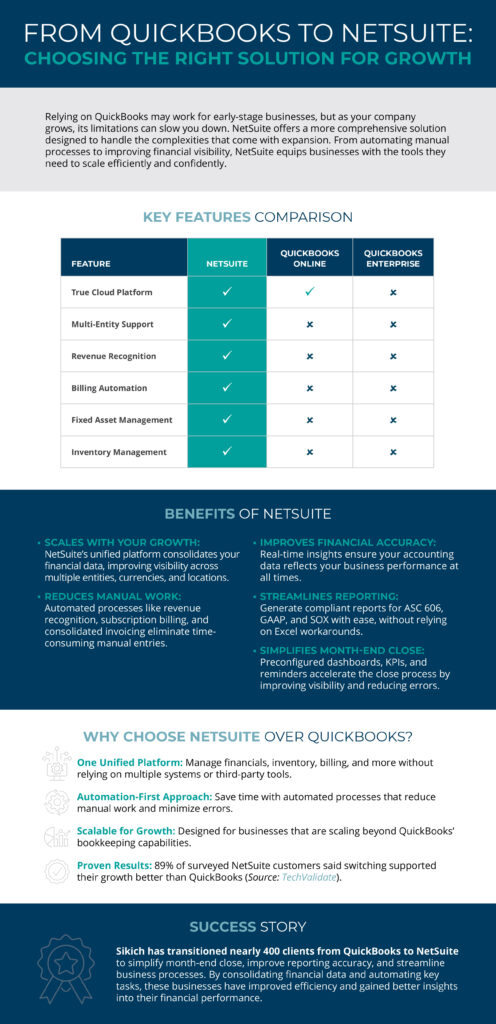
NetSuite unifies business operations. It connects accounting with inventory and links order management with CRM. Unlike QuickBooks, which was built for bookkeeping, NetSuite was designed to support growth across multiple operational functions.
Here’s how the transition from QuickBooks to NetSuite can help your growing business.
Unified System Architecture
Instead of switching between tools, your teams work from a centralized source of truth. Financials, CRM, inventory, order management, and even project accounting live in one place. Because every module writes to the same database, finance can generate a consolidated P&L or an inventory-aging report in minutes without exporting data to spreadsheets.
Real-time updates flow directly to dashboards, so leaders see variances as they occur and can take immediate action. Finance teams that made the switch report cutting month-end close times by 79%, showing that a single source of truth speeds analysis and decision-making.
Real-Time Data
Because NetSuite is a cloud-native platform, all users access the same real-time data, regardless of their location. There’s no need to manage servers or wait for file syncs. Updates happen automatically, and data flows seamlessly across departments. It ensures your reporting is always current and available on demand.
Businesses can access custom dashboards and up-to-date KPIs, giving them instant insight into the health of their business. Whether you’re managing a product launch or a multi-entity close, you see what’s happening now, not what happened last month.
Automation That Scales
NetSuite automates billing, purchasing, revenue recognition, and month-end close. That frees your finance team to focus on strategic analysis rather than manual-entry workarounds.
Scalability and Control
As your business expands, complexity does, too. NetSuite keeps growth manageable by tailoring each subsidiary with its own tax rules and local currency. A built-in consolidation engine brings every ledger into a single, authoritative view, providing leadership with accurate, group-wide performance insights without the need to export data to spreadsheets.
Role-based permissions reinforce governance along this journey. Team members access only the data and tasks they need, while automated approval chains protect critical workflows such as purchasing and vendor payments. The result is firm oversight that scales smoothly when you add new locations or bring additional business units online, all while avoiding bottlenecks for everyday users.
A TechValidate study found that 89% of NetSuite customers believe the move from QuickBooks positioned them for stronger, more sustainable growth, underscoring how the right platform can fuel expansion when it’s paired with a deliberate migration strategy.
Audit-Ready Compliance
QuickBooks handles basic bookkeeping, but it falls short when regulators demand controls. NetSuite addresses this gap by embedding compliance frameworks such as ASC 606 revenue recognition and SOX internal-control requirements into daily workflows. Finance teams will no longer maintain separate spreadsheets or plug-in tools to track contract obligations and approval histories; the system captures transactions in real-time and stores an audit trail for easy review.
Beyond automated logs, NetSuite uses role-based permissions and configurable approval chains to enforce the segregation of duties. Each action, whether it is posting a journal entry or releasing a vendor payment, creates a time-stamped record that auditors can trace back to the originating user. These guardrails limit errors and fraud while reducing the manual evidence gathering that typically bogs down an audit cycle.
Companies preparing for an IPO value these governance features even more. A NetSuite resource on ERP readiness notes that suites with built-in GRC capabilities give executives confidence in their filings and shorten the run-up to SEC reviews. Public filers also avoid the costly rip-and-replace projects that occur when entry-level software can no longer support evolving disclosure rules.
Case Study: Scholar Rock
Scholar Rock, a biotechnology company, needed to upgrade from QuickBooks after it was clear that SOX compliance and complex spending visibility were non-negotiable. The company couldn’t slice and dice their data the way they needed. As a public company, they also recognized the need to implement a new general ledger system.
NetSuite, implemented with support from Sikich, gave them that flexibility. The company streamlined vendor spend tracking and reduced miscoding by implementing custom workflows they hadn’t even known to ask for.
The Sikich team helped Scholar Rock go live mid-month, saving time and preventing disruptions to reporting. According to their team, “Sikich felt like true partners, not only through implementation but also post-go-live. They guided us through the pitfalls, offered recommendations we wouldn’t have thought of, and brought an experience that made a real difference.”
What the Transition Looks Like
With a partner like Sikich, moving from QuickBooks to NetSuite is a structured, collaborative process that sets businesses up for the long term.
A typical transition includes:
- Discovery and planning: Review your current workflows to identify the outcomes you want to achieve.
- Data migration and validation: Move your history and set up your chart of accounts.
- Configuration and testing: Customize and configure NetSuite to your workflows.
- Training and go-live support: Empower your team to use NetSuite from day one.
Sikich has helped nearly 400 businesses make this change. We’ve seen firsthand how the right platform transforms operations.
Contact Sikich today to take the first step toward a smarter and more scalable financial system.
This publication contains general information only and Sikich is not, by means of this publication, rendering accounting, business, financial, investment, legal, tax, or any other professional advice or services. This publication is not a substitute for such professional advice or services, nor should you use it as a basis for any decision, action or omission that may affect you or your business. Before making any decision, taking any action or omitting an action that may affect you or your business, you should consult a qualified professional advisor. In addition, this publication may contain certain content generated by an artificial intelligence (AI) language model. You acknowledge that Sikich shall not be responsible for any loss sustained by you or any person who relies on this publication.