







Is your organization ready to embrace a serverless future, one where you can take advantage of the full capabilities of cloud systems without the expense, physical space requirements, and maintenance needs of on-premise systems? And if so, what do you need to know to fulfill that vision?
Here are the considerations and options that we use when we help Sikich clients plan and execute an on-premise to cloud migration.
Why Move to a Serverless Office?
There are a lot of reasons why SMBs are increasingly migrating their systems to the cloud. For many, it’s been on their radar for some time. But even for businesses that have been planning this move, the following factors have increased their urgency:
- Remote workers. The pandemic accelerated the move to a remote workforce. The resulting challenges in delivering technology to remote users led businesses to rethink their office arrangements. In particular, it no longer makes much sense to pay for space for on-premise servers when team members are primarily working remotely.
- Better capabilities. The capabilities of cloud platforms have matured and are now performing as well or even better than on-premise infrastructure—both for remote and local users. Companies can also leverage new capabilities offered by cloud platforms, especially for collaboration.
- Bandwidth is now fast, reliable, and inexpensive. So, you don’t need to worry as much as you used to about having data that’s local to users, especially when most users aren’t in the office anyway.
- Line of Business application vendors are rapidly pivoting to cloud-based Software as a Service (SaaS). The SaaS versions of these applications now have equal or better performance capabilities than their on-premise versions, and vendors are creating strong incentives for clients to move to the cloud versions.
- Comfort Level. Clients have become more experienced over the past few years and more trusting of the cloud in general as they’ve become more accustomed to using cloud applications.
- Security is another driving factor, partly because the requirements to obtain cyber insurance are increasingly more difficult, and moving to cloud platforms can sometimes make it easier for businesses to comply.
- The Technology Cycle. Many clients are getting to the end of a cycle with their on-premise servers, office operating systems, or Line of Business applications. Others are shrinking their office footprints. So, they’re finding themselves at a fork in the road where they need to decide how to move forward, and the cloud seems like a better bet for the future, for all the reasons outlined above.
Going Serverless: The Path to Eliminating On-Premise Servers
When a business begins to seriously consider moving to the cloud for some or all applications, the next step is to look at the available options.
Below is a helpful reference for thinking about this decision to go to a serverless office. It’s called the Cloud Responsibility Chart, and it’s a good high-level representation of the available cloud platforms.
Moving from left to right, cloud platforms fall into three basic levels: Infrastructure as a Service (IaaS), Platform as a Service (PaaS), and Software as a Service (SaaS).
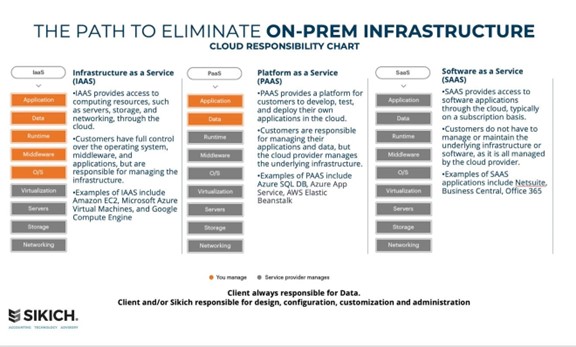
- Infrastructure as a Service is where we’re either building or moving virtual machines within the provider’s infrastructure. Options would include Azure Virtual Machines or Amazon EC2. With Infrastructure as a Service, there’s still an underlying operating system—either Microsoft or Linux—but the virtualization server, storage, and networking are all managed by the provider.
- Platform as a Service is a prebuilt platform where clients can build, develop, deploy, or manage their own applications—something like Azure SQL database or Azure logic apps. In the case of SQL, we wouldn’t build or migrate a SQL Server, we’d build or migrate a SQL database and run it within a server provider platform. That means there’s no OS for us to manage.
- Software as a Service is what we all commonly know as cloud-based applications, and there are hundreds of these. This is where the provider builds and manages all components of the infrastructure and application. This includes Office 365, NetSuite, Microsoft Dynamics 365 Business Central, or QuickBooks Online. The only thing we need to move in the case of Software as a Service is the data.
Every migration includes one or more of these platforms, and that depends on the details of the particular environment.
When you move from on-premise to one of these cloud platforms, the responsibility for management of certain parts of the infrastructure transfers to the service provider.
It’s also important to remember that in all cases, the ultimate responsibility for the data still rests with the client, and that comes into play when planning for security or disaster recovery.
Although the service provider may be responsible for managing the various components within the infrastructure, we, along with the client, are still responsible for the design, configuration, customization, administration, and support.
The Strategy for Moving to a Serverless Office
Based on the experience of Sikich’s Solution Architects, a successful migration to the cloud requires focusing not just on the technology itself, but on the needs of the business and what problems need to be solved.
Arriving at that crucial understanding requires four key questions: The Why, The What, The Where, and The How.
The Why
The Why is all about determining what is driving the impetus to change the environment structure. Some of those factors may include:
- Organizational goals and vision
- Hardware refresh cycle costs
- Access to resources
- Distributed or remote workforce
- Security
- Redundancy/availability
- Footprint consolidation
The What
Determining where to go is easier once we’ve analyzed what’s already in place. Some factors that are important to consider include:
- Identity/authentication
- Resources
- Line of Business applications and dependencies
- Endpoint management
- Remote access server hardware (VPN, RDS, AVD, etc.)
- Backups
- Compliance requirements
- Licensing
- Costs
The Where
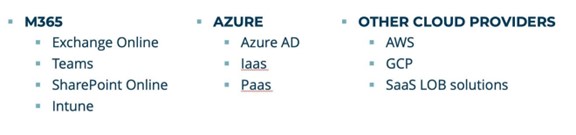
Once we’ve considered the reasons for the move and our goals, and analyzed the environment, we can better determine where to go. The options we recommend most often include Microsoft Dynamics 365 and Azure, although some clients may want to consider other providers, as well.
The How
All that leads us to the final question. How we proceed with the implementation will be largely determined by the Why, the What, and the Where. A few of the most important elements include:
Partner Engagement
There are different levels of partner involvement, but for Sikich, as a main service provider for our managed clients, our teams are highly integrated and intimately familiar with our clients’ environments, business needs, and operations. That helps us more effectively assist organizations in planning and executing their migration because there’s less discovery time needed.
Our options for this step may include scoping out and providing professional services for the entire project. We may start by performing an assessment to make sure we have all the necessary pieces in place. We may help with providing licensing and software. Or, for some clients, who have the necessary talent and capabilities in place, it might be a consulting engagement where we provide guidance to identify the right options, and then the client handles the execution.
Internal Team Involvement
Internal Team Involvement is another key part of the strategy—understanding which tasks will be performed by which teams, as well as the internal teams’ involvement in testing and any proprietary solution management.
Methodologies and Best Practices
Methodologies and best practices help determine the How, as well, to ensure that we choose the correct options based on needs and goals. This might involve a staged or a cutover approach, or depending on the scope of the project, it could be a series of projects.
Pilot programs can be helpful in testing the waters before proceeding with a migration. User and stakeholder training is another critical element: making sure that managers and their teams know what’s coming.
Compatibility and confirmation analysis need to be part of the planning, as well, to make sure that not just the right applications but the right versions are in place, as well as decisions about whether or not to upgrade applications that may or may not still be in use a couple of years down the road.
For a more detailed exploration of the process, including a step-by-step look at a specific use case scenario for moving to a serverless office, watch our Achieving the Serverless Office 2023 Webinar featuring Sikich vCIO Rick Vines and Solution Architect Jon Cole.
Ready to talk about moving to a serverless office? Please contact us at any time!
This publication contains general information only and Sikich is not, by means of this publication, rendering accounting, business, financial, investment, legal, tax, or any other professional advice or services. This publication is not a substitute for such professional advice or services, nor should you use it as a basis for any decision, action or omission that may affect you or your business. Before making any decision, taking any action or omitting an action that may affect you or your business, you should consult a qualified professional advisor. In addition, this publication may contain certain content generated by an artificial intelligence (AI) language model. You acknowledge that Sikich shall not be responsible for any loss sustained by you or any person who relies on this publication.