






The recently enacted “Tax Cuts and Jobs Act” (The Act) features numerous tax provisions impacting businesses in all industries. The following is a brief overview of selected major changes affecting the construction and real estate industry.
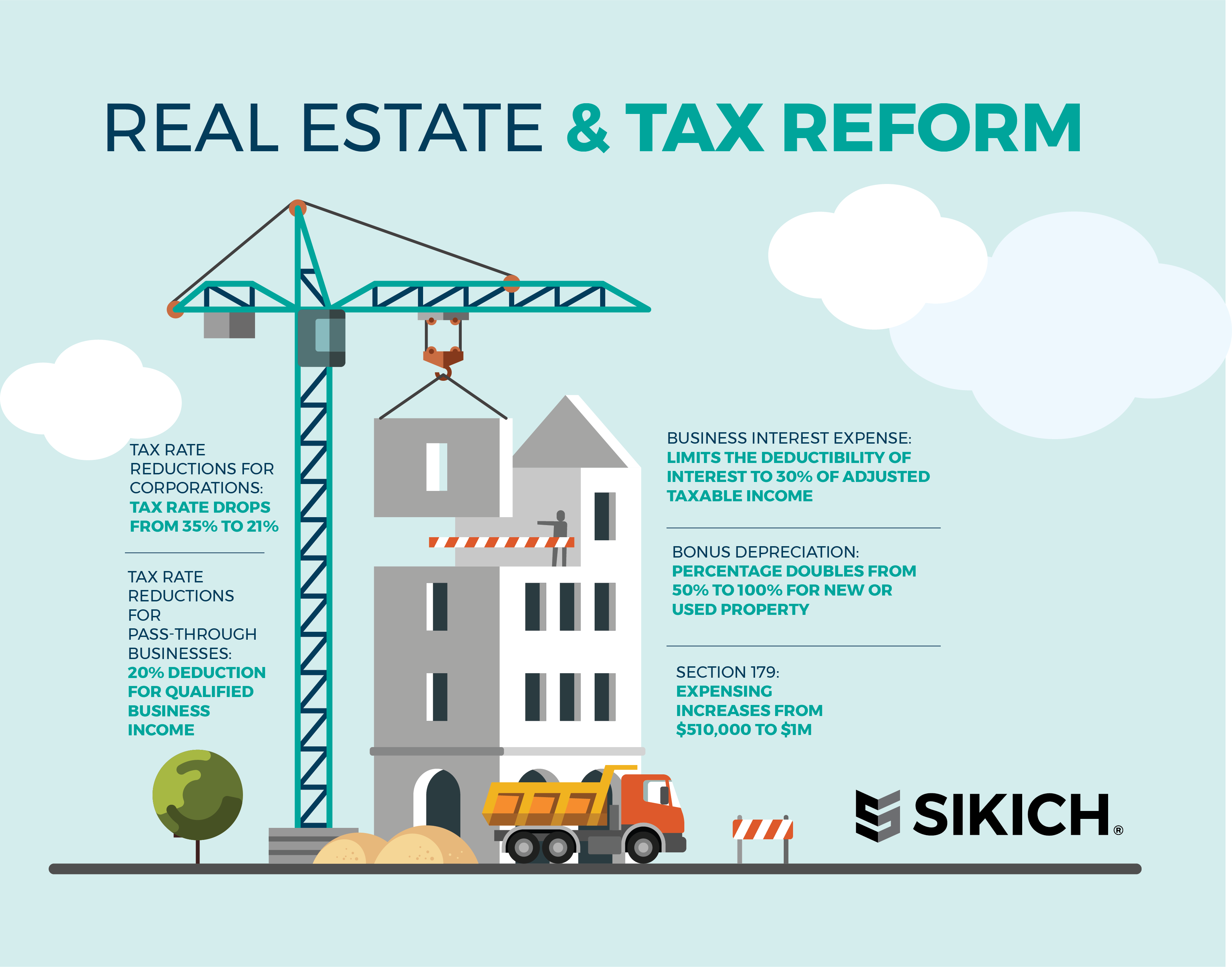
Under the Act, the corporate tax rate drops from 35 percent to 21 percent. In addition to this new lower rate, the Act also repeals the corporate Alternative Minimum Tax (AMT). These changes both apply in 2018 – there is no phase-in period.
Many construction and real estate businesses are set up as “pass-through businesses” (Partnerships and S Corporations). Rather than a lower tax rate, they will benefit in the form of a new 20 percent tax deduction for “qualified business income.” However, the new tax law adds a limitation to this 20 percent deduction that is set as the greater of:
- 50% of wages paid by the business; or
- 25% of wages paid by the business, plus 2.5% of original cost of property used in the business.
For bonus depreciation, the deduction doubles from 50 percent to 100 percent for new or used qualified property that is acquired and placed in service date after September 27, 2017. In addition, there was an increase from $510,000 to $1,000,000 for Section 179 expensing rules for 2018.
Finally, the deductibility of business interest expense is limited to 30 percent of Adjusted Taxable Income (ATI), with a general exception for small businesses and any trade or business involved in real property. This will likely be a key issue impacting many real estate companies.
For more information, read our in-depth article on Tax Reform’s Impact on the Construction and Real Estate Industry in Sikich’s Series on Tax Reform.
This publication contains general information only and Sikich is not, by means of this publication, rendering accounting, business, financial, investment, legal, tax, or any other professional advice or services. This publication is not a substitute for such professional advice or services, nor should you use it as a basis for any decision, action or omission that may affect you or your business. Before making any decision, taking any action or omitting an action that may affect you or your business, you should consult a qualified professional advisor. In addition, this publication may contain certain content generated by an artificial intelligence (AI) language model. You acknowledge that Sikich shall not be responsible for any loss sustained by you or any person who relies on this publication.