







For supply chain orgs, sales order processing remains one of the most manual and operationally fragile parts of the business.
Many orders still arrive through email as PDFs, spreadsheets, or scanned documents. What follows is often a slow, error-prone process that struggles to scale as volumes grow.
This is where the Dynamics 365 Sales Order Agent has an impact.
The reality of manual, email-based order intake
Manufacturers and distributors often spend a disproportionate amount of time managing inboxes rather than processing orders. Incoming emails must be opened, attachments reviewed, and purchase orders identified before work can even begin. In high-volume environments, this manual triage can consume hours each day.
When an order is identified, key details must be manually entered into Microsoft Dynamics 365 Finance & Supply Chain Management (F&SCM). Line items, quantities, pricing, delivery dates, and customer information are rekeyed from the purchase order into the system. Each step introduces risk, including missed fields, incorrect pricing, duplicate entries, or errors that may not surface until fulfillment is underway.
Even small data-entry mistakes—such as incorrect quantities or pricing discrepancies—can lead to order rework, shipment delays, returns, credit memos, and customer service escalations.
What should be a real-time transaction can take hours or even days, particularly when orders require clarification, corrections, or rework. These delays flow downstream, affecting inventory allocation, shipping timelines, and customer satisfaction.
As a result, sales and operations teams spend time on repetitive, low-value tasks instead of exception management, customer engagement, or process improvement. As order volumes increase, headcount and operating costs scale with them.
Compounding these challenges is a lack of visibility. Order details are scattered across inboxes and attachments, making it difficult to track status, identify bottlenecks, or establish a single source of truth. Without centralized order data, teams can’t enforce consistency or maintain a complete audit trail, increasing the risk that incomplete records, incorrect pricing, or missing data go unnoticed.
Taken together, manual order management hurts the customer experience, slows cash flow, increases operational risk, and limits your ability to scale efficiently without adding headcount.
How the D365 Sales Order Agent changes the equation
The Dynamics 365 Sales Order Agent addresses these challenges by automating the most time-consuming and error-prone steps in your order intake process.
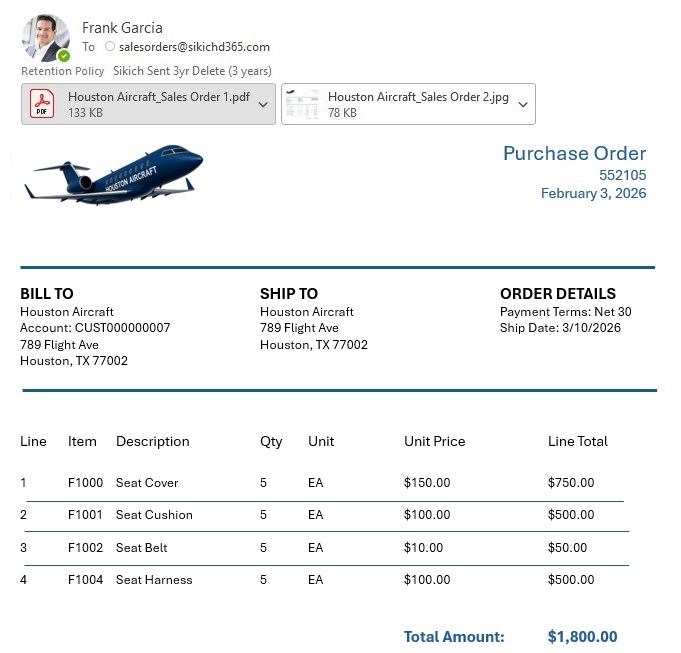
Inbound orders are automatically captured from documents, reducing reliance on manual email sorting and attachment handling. AI-powered data extraction pulls key order details directly from purchase orders, significantly reducing the need for rekeying and minimizing errors.
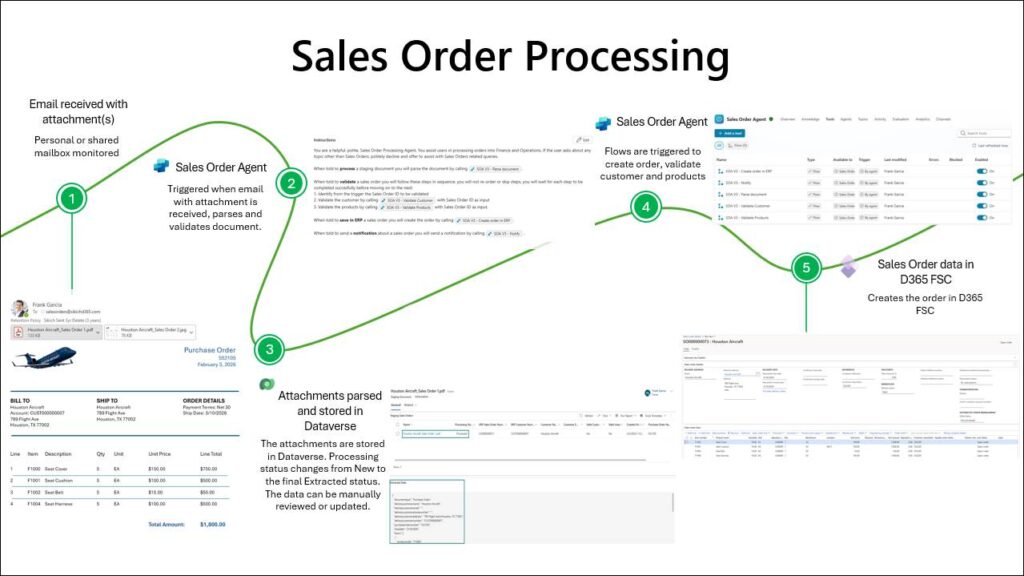
Because sales orders are created directly within Dynamics 365 Finance & Supply Chain Management (F&SCM), data stays in the system of record. This improves accuracy, shortens cycle times, and provides visibility into order status for sales, operations, and finance teams.
The Sales Order Agent includes autonomous email processing, monitors mailbox for email attachments, and supports PDF documents and image files (JPG, PNG, JPEG).
The Sales Order Agent enables manufacturers and distributors to move orders from receipt to creation in minutes and can be tailored to fit unique business processes, systems, and future automation needs.
D365 Sales Order Agent’s benefits for manufacturers and distributors
Automating sales order intake delivers measurable benefits:
- Reduced errors: AI-driven extraction minimizes data entry mistakes and costly rework
- Faster cycle times: Orders flow into the system more quickly, accelerating fulfillment
- Lower cost to serve: Teams spend less time on repetitive tasks and more time on value-added work
- Improved visibility: Centralized order data creates a clear, auditable source of truth
- Stronger compliance: Complete, consistent records reduce pricing, audit, and regulatory risk
Beyond sales orders, the D365 Sales Order Agent provides a scalable foundation that can support additional document types such as invoices, delivery notes, and other order-related workflows. This allows supply chain orgs to extend automation without introducing disconnected tools or workarounds.
Manual, email-driven order intake creates unnecessary friction, cost, and risk. By automating order capture and creation directly within Dynamics 365 Finance & Supply Chain Management (F&SCM), the Sales Order Agent helps you improve speed, accuracy, and visibility.
Reach out today to learn more.
This publication contains general information only and Sikich is not, by means of this publication, rendering accounting, business, financial, investment, legal, tax, or any other professional advice or services. This publication is not a substitute for such professional advice or services, nor should you use it as a basis for any decision, action or omission that may affect you or your business. Before making any decision, taking any action or omitting an action that may affect you or your business, you should consult a qualified professional advisor. In addition, this publication may contain certain content generated by an artificial intelligence (AI) language model. You acknowledge that Sikich shall not be responsible for any loss sustained by you or any person who relies on this publication.